Category: Learn

  • KPIs for Startups in India: The Complete Guide to Measuring What Matters

    KPIs for Startups in India: The Complete Guide to Measuring What Matters

    Discover the most critical KPIs for startups in India from revenue metrics to customer acquisition costs. A practical, founder-first guide to tracking growth in the Indian startup ecosystem.

    Introduction: Why Most Indian Startups Measure the Wrong Things

    India is now home to over 115,000 recognized startups and more than 100 unicorns. Yet a majority of early-stage founders spend their first two years obsessing over vanity metrics app downloads, social media followers, press mentions while ignoring the numbers that actually predict survival.

    KPIs, or Key Performance Indicators, are not just investor-speak. They are the vital signs of your business. Tracked correctly, they tell you when to accelerate, when to pivot, and when to stop burning cash on something that isn’t working.

    This guide breaks down the most important KPIs for Indian startups, organized by stage and function, so you can build a metrics culture from day one.

    What Is a KPI and Why Does It Matter for Indian Startups?

    A Key Performance Indicator is a measurable value that demonstrates how effectively a company is achieving its key business objectives. For startups, KPIs serve three purposes:

    First, they create internal alignment. When everyone on a 10-person team knows the north star metric, decisions get faster and smarter.

    Second, they build investor trust. Whether you’re pitching to angel networks in Bengaluru, seed funds in Mumbai, or Series A investors with global portfolios, investors use KPIs to benchmark you against comparable companies.

    Third, they reveal the truth faster than gut instinct. Indian startup founders often operate in high-noise environments rapid market changes, regulatory shifts, intense competition from both domestic and global players. Data cuts through the noise.

    The Right KPIs by Stage

    Pre-Revenue / Ideation Stage

    At this stage, you’re validating assumptions, not scaling a business. Your KPIs should reflect learning velocity, not financial performance.

    Customer Discovery Conversations (weekly): Track how many potential customers you’re speaking to each week. Aim for 5–10 deep interviews. This is your most important activity at this stage.

    Problem-Solution Fit Score: After each interview, rate (1–5) whether your proposed solution meaningfully addresses the problem the customer described. Aggregate scores week-over-week.

    Waitlist Sign-up Rate: If you’ve built a landing page, what percentage of visitors convert to waitlist sign-ups? A 10–15% conversion rate signals real demand. Below 5% is a flag.

    Prototype Iteration Cycle Time: How many days does it take to build, test, and learn from one iteration? Faster cycles mean faster learning.

    Early-Stage Startups 

    This is where the fundamentals get established. The KPIs here determine whether you have a business or a project.

    Revenue KPIs

    Monthly Recurring Revenue (MRR): For SaaS, edtech, fintech, or any subscription business, MRR is the single most important number. It tells you what your business earns predictably every month. Track MRR growth rate month-on-month — a healthy early-stage SaaS company in India should be growing MRR 10–20% monthly.

    Annual Recurring Revenue (ARR): MRR multiplied by 12. Investors use this to benchmark valuation. Most Series A investors in India look for ₹2–5 crore ARR as a starting point for conversation.

    Revenue Growth Rate (MoM and YoY): Month-on-month growth tells you short-term momentum. Year-on-year reveals whether you’re building something durable. Don’t mix the two.

    Average Revenue Per User (ARPU): Total revenue divided by the number of paying customers. Low ARPU with high user counts is a common Indian startup trap — impressive numbers that don’t add up to a viable business.

    Customer KPIs

    Customer Acquisition Cost (CAC): Total sales and marketing spend divided by the number of new customers acquired in a given period. In India, benchmarks vary widely by sector. B2C fintech CACs can run ₹50–500. B2B SaaS CACs can range from ₹5,000 to ₹ 50,000, depending on deal size.

    Customer Lifetime Value (LTV): The total revenue you expect from a single customer over their entire relationship with your product. The LTV: CAC ratio is the closest thing to a universal health metric for a startup. A ratio below 1:1 means you’re losing money on every customer. A ratio of 3:1 is considered the baseline for a sustainable business.

    Churn Rate: The percentage of customers who stop paying you each month. In Indian markets, where price sensitivity is high and switching costs are often low, churn is frequently the silent killer. Monthly churn above 5% is a serious problem that should take priority over growth.

    Net Revenue Retention (NRR): NRR measures whether your existing customers are paying you more or less over time, accounting for upgrades, downgrades, and churn. An NRR above 100% means your existing customer base is growing without acquiring a single new customer. This is the gold standard for Indian B2B SaaS companies.

    Product KPIs

    Daily Active Users / Monthly Active Users (DAU/MAU): The DAU/MAU ratio, sometimes called the “stickiness ratio,” shows how frequently users return. A ratio above 20% is considered good; above 50% is exceptional. WhatsApp-level products in India achieve 80%+.

    Activation Rate: The percentage of new sign-ups who complete a defined “first value” action within a set time window. Identify the single action most correlated with long-term retention and make that your activation event.

    Feature Adoption Rate: For product teams, this tracks what percentage of users are using specific features. Useful for prioritization — kill low-adoption features, invest in high-adoption ones.

    Key Takeaways

    KPIs are not a reporting exercise. They are a decision-making tool. The best Indian startup founders treat their metrics like a pilot treats flight instruments — not because they’re required to, but because they can’t safely navigate without them.

    At the pre-revenue stage, measure learning speed. At the early stage, measure retention and unit economics. Pick 3–5 metrics that truly matter right now. Build a dashboard you’ll actually use, review it weekly, and let the data tell you when it’s time to scale.

    The startups that survive India’s hyper-competitive, capital-constrained market are rarely the ones with the most funding or the flashiest product. They’re the ones that know their numbers cold and act on them fast.
  • Are we judging startups too harshly?

    Are we judging startups too harshly?

    What did Swiggy do right that Tiny Owl didn’t?

    • Diverse Choices & Restaurant Inventory: Swiggy quickly onboarded a wide range of local restaurants.
    • Speed & Delivery Efficiency: Swiggy’s superior tech and in-house delivery fleet ensured fast, reliable deliveries with short Estimated Time of Arrivals( ETAs)
    • Trust & Transparency: Features like live delivery tracking and item photos built customer trust and loyalty.
    • Focused Delivery Fleet: Swiggy owns and trains its own fleet, ensuring a seamless experience without multiple calls from delivery personnel.

    What Went Wrong for TinyOwl:

    • Over-Hiring & Inefficiency: TinyOwl expanded too quickly, leading to inefficiency and poor service quality. They over-hired and couldn’t establish proper organizational structures.
    • Scaling Without Core Metrics: Focusing too much on growth without refining core operations led to a strain on unit economics.
    • Lack of Strategic Clarity: TinyOwl’s strategies, including the abandonment of its delivery fleet, resulted in high cash burn and lower margins.

    Shubham Bansal, TinyOwl’s founder, put it best

     Swiggy’s strategy was better. While Tiny Owl focused on the food discovery/ordering experience, Swiggy focused on building a logistics network. In hindsight, logistics was a main problem to be solved. BUT ONLY IN HINDSIGHT.No one could have predicted at that time. Any other reason and criticism about startups is a waste of your time, and shows poorly more on people criticising than those who tried building.”

    The Lesson

    •   He acknowledges that Swiggy focused on solving the right problem — logistics. In the food delivery space, ensuring that the food reaches the customer on time, hot, and reliably has turned out to be the critical success factor.
    • TinyOwl tried to make browsing and ordering easy, but it didn’t invest heavily in solving the messy, real-world delivery issues. Swiggy, on the other hand, went all-in on building its delivery fleet and systems — something that later became its moat.
    • At that time, no one knew for sure which approach would work. Food tech was still new, and many assumed better UX (user experience) would win. Only after the market evolved did it become clear that logistics was the real bottleneck.

    It wasn’t about who raised more — it was about who solved the right problem first.

    Building a startup means taking bets with incomplete information. Some work. Some don’t.

     Do we judge failed startups too harshly — and forget how much courage it takes to build one?

    Sources: https://growquik.in/swiggy-business-model-marketing-strategy

    https://x.com/BakarBansal/status/1933051417352134663

    https://timesofindia.indiatimes.com/business/startups/trend-tracking/the-rise-and-fall-of-tinyowl-lessons-that-start-up-founder-saurabh-goyal-learnt/articleshow/60069264.cms

    FAQs

    1. Are startups judged too harshly in the early stage?

    Yes, many startups are judged too quickly without understanding the challenges of building a business from scratch and the time it takes to grow.

    2. Why do people think startups fail easily?

    People often focus on visible failures without seeing the learning, effort, and experimentation behind every startup journey.

    3. What challenges do early stage startups face?

    Startups face challenges like limited funding, unclear direction, market validation issues, and building the right team.

    4. Is failure common in startups?

    Yes, failure is common and often part of the learning process that helps founders improve and build better businesses.

    5. How should startup failures be viewed?

    Startup failures should be seen as learning experiences rather than final outcomes, as they help founders grow and refine their ideas.

    6. Why do investors reject many startups?

    Investors may reject startups due to lack of clarity, weak validation, or insufficient traction, not necessarily because the idea is bad.

    7. How can founders deal with criticism and pressure?

    Founders can handle criticism by focusing on feedback, improving their approach, and staying consistent with their vision.

  • Empowering Women Entrepreneurs: Raise up to Rs. 50 lakhs for seed funding by applying for SISFS through STEP

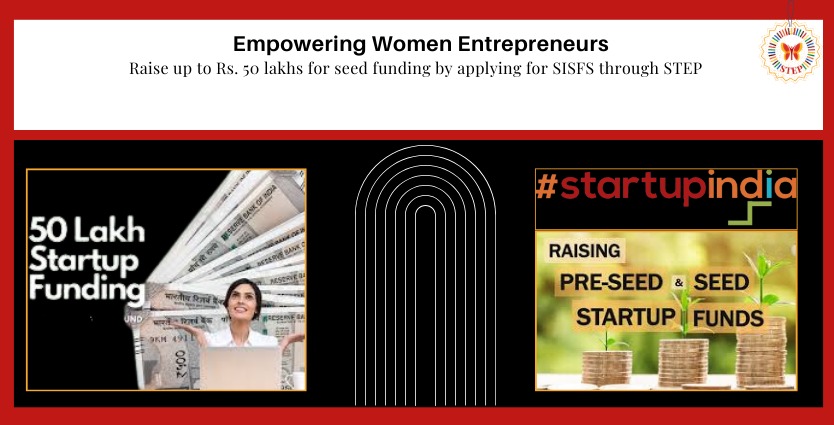
    Empowering Women Entrepreneurs: Raise up to Rs. 50 lakhs for seed funding by applying for SISFS through STEP

    Are you a woman founder with an innovative idea who needs help securing seed funding? Are you seeking financial support to turn your idea into reality, develop a prototype, conduct product trials, or bring it to market?

    About SISFS

    DPIIT’s Startup India Seed Fund Scheme, with a significant outlay of INR 945 Crore, is dedicated to providing financial support for idea validation, product development, market entry, and scaling. 

    Highlights of SISFS:

    • Year-Round Call for Applications: Startups can apply anytime.
    • Sector-Agnostic: Open to all sectors, from tech to social enterprises.
    • Flexible Incubation: No mandatory in-person incubation; apply from anywhere in India.
    • Collateral-free loans: The Startup India Seed Fund Scheme (SISFS) does not require collateral.
    • Apply to Multiple Incubators: Startups can submit applications to 3 incubators simultaneously.

    STEP is a recognized incubator by Startup India for the Startup India Seed Fund Scheme to provide seed funds to selected women-led startups.

    To Apply now through STEP, click here, and choose CGLS Foundation as your first preference.

    This program offers selected startups grants of up to Rs. 20 lakhs and debt funding of up to Rs. 50 lakhs at the repo rate In addition, mentorship with STEP is provided to help bring your idea to life.

    Why Apply Through STEP?

    At STEP, we understand the unique challenges women entrepreneurs face. SISFS through STEP is designed exclusively for women and non-binary founders, giving you a better chance of securing funding compared to other programs. With STEP’s guidance, you’re not only receiving funding but joining a supportive community that’s invested in your success.

    Who Can Apply?

    STEP welcomes applications from those who:

    • Identify as Women or Non-Binary: Inclusive and supportive of diverse founders.
    • Registered Entities: Your startup should be a Private Limited, LLP, or OPC.
    • Recently Incorporated: Startups incorporated within the last two years are eligible.
    • DPIIT Recognition: Obtain a DPIIT number for eligibility. Get DPIIT-recognized here.
    • Innovative Solutions: Preference for startups creating impactful and original solutions.
    • Technologically Driven: Startups should use technology as part of their core solution, business, or distribution model.
    • Funding Limit: Should not have received more than Rs. 10 lakh in prior government support.
    • Ownership Structure: A minimum of 51% Indian ownership as per the Companies Act and SEBI regulations.

    Ready to Bring Your Idea to Life?

    Apply now through STEP by selecting CGLS Foundation as your top preference incubator. Here, you’ll find the backing you need, from financial assistance to hands-on mentorship. Embrace the opportunity to scale up your business idea with STEP’s support in the SISFS program—join us in building a future led by women entrepreneurs!

    FAQs

    1. What is the Startup India Seed Fund Scheme (SISFS)?

    SISFS is a government initiative that provides financial support to early stage startups for idea validation, prototype development, and market entry.

    2. How much funding can startups get under SISFS?

    Eligible startups can receive up to ₹20 lakhs for proof of concept and up to ₹50 lakhs for product development and scaling.

    3. Who can apply for SISFS funding?

    Early stage startups with innovative ideas, a scalable business model, and registration in India can apply for SISFS funding.

    4. How can women entrepreneurs benefit from SISFS?

    Women entrepreneurs can access funding, mentorship, and support to build and grow their startups with reduced financial barriers.

    5. What is the role of incubators in SISFS?

    Incubators help startups apply for funding, provide mentorship, and support them throughout the evaluation and growth process.

    6. How can startups apply for SISFS through STEP?

    Startups can apply through STEP by submitting their idea, business plan, and required documents as per the program guidelines.

    7. What are the key benefits of SISFS funding?

    Key benefits include financial support, reduced risk, access to mentorship, and opportunities to scale startups faster.

  • Hasirudala: Bringing dignity to waste pickers

    Hasirudala: Bringing dignity to waste pickers

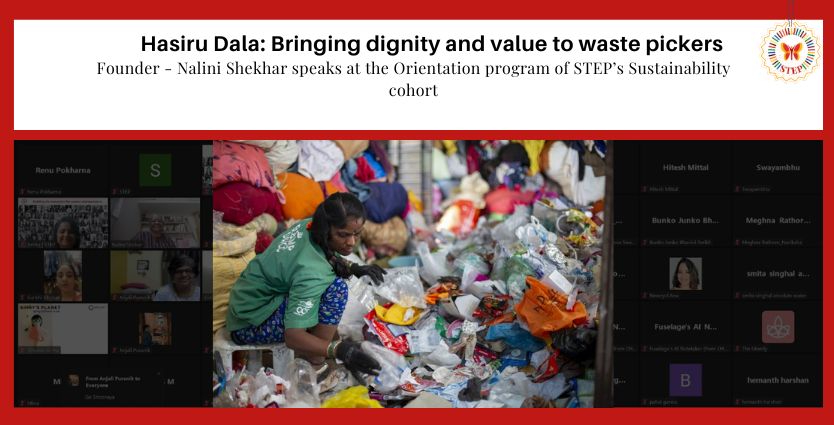
    ( Following is an excerpt of Ms. Nalini Shekhar’s inspiring speech at the orientation program of STEP’s sustainability cohort. Nalini Shekar is the co-founder and Executive Director of Hasiru Dala, a social impact organisation working with waste pickers and other waste workers to ensure a life with dignity.)

    Indumathi’s Journey: From Waste Picker to Award-Winning Entrepreneur

    A few years ago, Indumathi walked the streets of Bengaluru with a heavy sack on her shoulder, tirelessly collecting recyclable waste. Her work was gruelling, filled with countless bends and stretches, yet she earned just enough to keep her family going. Her children couldn’t go to school because she couldn’t afford it, and even putting a single meal on the table was a struggle. Some days, she had to borrow food meant for cattle to feed her family.

    When Hasirudala first met Indumathi about a decade ago, they offered her a scholarship for her children’s education. She didn’t hesitate to accept, and despite her challenging circumstances, she ensured her children went to school. Today, Indumathi is a different person. She’s been recognized with the Namma Bengaluru Award for Social Entrepreneurship and now runs her own company.

    Indumathi has 88 people working under her, though she still insists on collecting waste herself. She doesn’t read and write, but all her transactions for her workers’ payments are online,  and she knows how to manage her money very well,” says Nalini.

    Indumathi’s story is just one example of the impact Hasirudala has made. 

    And today, waste pickers from different parts of Karnataka where Hasirudala doesn’t work, ask Hasirudala if they can work with the organisation.

    That is the change that has happened in ten years in the lives of waste pickers.

    Hasirudala also played a key role in making Bengaluru the first city in India to sign a MOU between waste pickers and the local government, formalising their essential role in managing the city’s waste.

    “ We just created a platform for them to move forward and become entrepreneurs,” says Nalini.

    Taking on Bengaluru’s Waste Crisis

    Back in 2011-12, Bengaluru faced a major waste crisis. Landfills were overflowing, and the communities living near them had had enough. The city was overwhelmed by the smell of unprocessed waste, and something needed to change. Hasirudala, still a young organisation at the time, stepped up.

    It wasn’t easy initially.  Waste pickers were cautious as promises had let them down never kept, and trusting another organisation wasn’t easy. But sometimes, all it takes is one person to start a movement. 

    For Hasirudala, that person was Annamma, a waste picker who decided to give them a chance. Her courage encouraged others to join, and soon, a network of waste pickers began to form across Karnataka, united by a shared hope for a better future.

    We had just begun working with waste pickers and I told them to put on gloves and shoes and just start picking up waste. And then we started pulling out only recyclable or inorganic waste from that pile,’ says Shekhar.

    In just two days, they pulled out 10 tons of recyclable material, showing everyone what was possible with organised waste management.

    Hasirudala approached the local government with a simple question: Why send all this waste to landfills when so much of it can be recycled? They proposed creating a dry waste collection center in each ward, which could drastically reduce the amount of waste heading to landfills. The government agreed, and soon, they had one or two buildings allocated for this purpose.

    Hasirudala initially planned scrap dealers or the retail market could manage the dry waste collection centers. But the waste pickers spoke up, saying they wanted to run this. Hasirudala partnered with Jain College to start a session and certificate course specifically for them. Since the waste pickers couldn’t read or write they introduced a lot of hands-on, experiential learning. 

    Today, 87 entrepreneurs have emerged from this effort, with 42% of them being women.

    Innovating for a Sustainable Future

    Hasirudala has transformed waste management in Bengaluru by tackling inefficiencies and bringing clarity to a system previously plagued by double payments and poor service. In the early days, contractors were collecting waste from apartments and charging both the government and private entities for the same work. Seeing an opportunity for change, Hasirudala proposed managing waste collection for bulk waste generators, and integrating waste pickers into the process. This led to the development of a unique model where waste pickers became entrepreneurs, responsible for collecting and sorting dry waste. “We were operating in uncharted territory,” says Shekar, “But we knew we could make it work with the city, the waste pickers, and the citizens on our side.”

    As Hasirudala’s work grew, so did their innovations. They established Hasiru Dala Innovations, a company that now services over 40,000 households in Bengaluru. 

    Today, Hasirudala Innovations services over 40,000 households, adhering to the “polluter pays” principle, meaning waste isn’t collected unless properly segregated. The organisation has also expanded into other innovative areas.

    We bottle the CNG gas and send it to hotels, while the slurry byproduct is provided to farmers,” says Nalini Shekar. “The waste we process creates two valuable byproducts, contributing to both sustainable energy and agriculture.”

    30% of the buttons used in H&M garments across Asia now contain PET plastic collected by Hasirudala Innovations. Additionally, 50% of Sunsilk’s Natural shampoo bottles use plastic collected by them.

    Hasirudala Innovations is also a World Trade Organisation certified for fair trade operations.

    Hasirudala has even broken new ground in textile waste collection, educating residents on donating clean, recyclable clothes. 

    This is just the beginning,” Nalini reflects. “With each new challenge, we continue to innovate, driven by our commitment to empower waste pickers and create a more sustainable world.”

    Looking to the Future

    Hasirudala’s success shows what can happen when communities come together with a shared goal. Starting with just three co-founders, each bringing different strengths to the table, the organisation has grown into a strong force for change in Bengaluru and beyond.

    But their journey is far from over. With 3,500 jobs created so far, Hasirudala aims to create 20,000 more, continuing to help waste pickers rise out of poverty and become successful entrepreneurs. They’re also expanding their work, including launching Bengaluru’s first textile recycling aggregation center, which will be led by Indumathi herself.

    Hasirudala’s story is about more than just managing waste. It’s about dignity, empowerment, and the belief that everyone has the potential to make a difference, no matter where they come from. As they continue to innovate and expand, Hasirudala is not only cleaning up Bengaluru but also creating a more inclusive and sustainable future for everyone.

    FAQs

    1. What is Hasirudala?

    Hasirudala is a social enterprise in India that works to empower waste pickers by providing them with identity, dignity, and better livelihood opportunities.

    2. How does Hasirudala support waste pickers?

    It supports waste pickers through training, fair wages, identity recognition, and integration into formal waste management systems.

    3. Why are waste pickers important in India?

    Waste pickers play a crucial role in recycling and waste management, helping reduce environmental impact and manage urban waste effectively.

    4. What challenges do waste pickers face?

    Waste pickers often face low income, lack of recognition, poor working conditions, and social stigma.

    5. How does Hasirudala promote sustainability?

    Hasirudala promotes sustainability by improving recycling systems, reducing waste, and creating structured waste management solutions.

    6. Are women involved in waste picking in India?

    Yes, a large number of waste pickers in India are women, and they play a key role in waste collection and recycling.

    7. How can social enterprises improve waste management in India?

    Social enterprises can organize informal workers, provide resources, and build systems that improve efficiency and sustainability.

  • Baking Dreams into Reality: Anika Gupta, the teenage philanthropist & kidpreneur

    Baking Dreams into Reality: Anika Gupta, the teenage philanthropist & kidpreneur

    Meet Anika, the 14-year-old dynamo from Kanpur with a mischievous smile that hides a world of innovative entrepreneurship. She’s not your ordinary teen – she’s the proud winner of the Kidpreneurs Award 2023, where her startup, ABC (Anika Bakes Cakes), stole the spotlight for its unparalleled creativity.

    Anika’s journey began in her family kitchen, where her love for baking blossomed into a full-fledged business. Her secret? Using top-quality ingredients to craft delectable treats sets ABC apart from the rest. But what truly distinguishes her is her heart – sharing 50% of profits with her kitchen helpers, turning her passion into a force for good.

    Her Inspiration 

    Ever since she was a child, Anika loved baking and used to watch baking shows with her family. She started experimenting with recipes.

    Every time I baked something for my family and friends, the smiles on their faces encouraged me to pursue my dream,” she says.

    When the lockdown happened, she launched ABC, combining her love for baking with a desire to create something special. 

    The goodies on her menu include Nutella mudpuds, coconut pudding, mango gelato, brownies, chocolate chip cookies, etc.

    She has taken 900 + orders to date. Her biggest order was 140 baby announcement hampers for a client. Everything is made in her home kitchen.

    It is a profitable setup unless she chooses to donate to a cause.

    “Baking isn’t just a business for me; it’s a form of relaxation and joy. I make sure not to overburden myself and keep stress at bay. It’s all about maintaining balance. This means sometimes saying no to orders if it conflicts with my studies or personal time,” she adds.

    Once the lockdown was over, balancing school and her business became difficult.

     “I’ve found that taking most of my orders on weekends works best as it allows me to focus on academics during the week,” she says.

      Anika is grateful for the support of her family, friends, teachers, and customers.

    Anika, the philanthropist

    Anika is an avid book reader. She learned from her mother that children in many schools nearby barely had access to school books.

    I believe every child deserves the chance to explore new worlds and dreams through books,” she says.

    At age eight, she started the ‘Let’s Read’ campaign to set up libraries in underprivileged schools around Kanpur. 

    Using the portable Pratham Book Wall, she has opened 17 libraries so far. 

    When I go to these schools, I get to see how these books bring curiosity and happiness to the lives of the children there. The teachers feel that books have brought positivity in students’ learning attitudes,” she adds.

    Anika plans to expand the “Let’s Read” program beyond Kanpur District.

    Anika is a dog lover and is crazy about her dog, Cocoa. When a storm ruined a dog shelter, Anika contacted the owner and organized a fundraising campaign. 100% of the funds raised from her campaign were allocated to this cause, and she donated the proceeds for all her orders to build another shelter for dogs. 

    Experience at the Kidpreneurs Award 2023 

    Recently, Anika took part in the Kidpreneurs Award in 2023, held in Delhi. Setting up a stall for the first time to showcase and sell her products to a new clientele was a challenging yet exciting prospect for her. Among more than 20 kidpreneurs’ stalls, her endeavor stood out.

     “Winning the Kidpreneurs Award was a surreal experience and gave me the confidence to dream big, ” she adds. 

    Lessons from the Entrepreneurial Journey

    • Learn to share
    • Be exclusive
    • Understand your customers
    • Listen to your instincts to make decisions
    • Manage time efficiently
    • Plan your financials  wisely

    I want to embrace new challenges and learn more lessons in the future to shape me as an entrepreneur,” she adds.

    Message to Gen Z

    Embrace what you love and never feel embarrassed about your passions. Do not get discouraged by others’ opinions, as staying true to your beliefs and passion is the most fulfilling,” is Anika’s message to Gen Z.

    Anika, the person

    Anika describes herself as passionate, supportive, and versatile. She draws inspiration from her mother’s hard-working nature and is grateful for her support. Her mother, Ms. Aarti Gupta, National Head of FICCI FLO Startup Cell, also manages ABC’s Instagram account. She wants to pursue history and economics in the future and loves visiting historical places. A quote that is the mantra of her life is,” Love yourself and be your biggest support.” 

  • In conversation with Prachi Jain

    In conversation with Prachi Jain

    Darwin’s theory of evolution applies to startups as well. Like in nature, survival in the startup world depends on adaptation, seizing opportunities, and persistence. Just as species thrive in the right environment, startups, too, require a supportive ecosystem to flourish,” says Prachi Jain, Chartered Accountant, Company Secretary, LLB with 15+ years of diversified experience in the Private Equity and Venture Capital Industry.

    The Professional Journey

    Prachi hails from Gwalior, Madhya Pradesh, and initially wanted to become an IAS officer. However, following her father’s advice, she decided to pursue a career in Chartered Accountancy. She achieved the 19th All India Rank in the CA Level I exam on her first attempt, repeated her success in the second level, and secured a 42nd rank.

    This success led to an internship at RSM & Co (acquired by PWC) in Mumbai, she acknowledges the guidance and mentorship of her seniors during this time. 

    “Moving from a small city to Mumbai was initially daunting and overwhelming, but I embraced the challenge because I wanted to fulfill my father’s dream and become a CA,” she adds.

    During the same period, she successfully cleared the CS exams and earned a Bachelor of Law degree. Prachi believes in updating her skills and received a certificate in ESG Investing from CFA and also has a Gender Lens Investing Fellowship, Asia by 2x Global and Value for Women. The latest feather in her cap is the Goldman Sachs Entrepreneurship course from IIM Bangalore.

    Her professional journey coincided with India’s financial boom in 2004-2005. She joined a private equity fund, specializing in food and agribusiness sustainable investments.

    “My expertise in fund and transaction structuring along with financial acumen developed during articleship proved invaluable,” she admits.

    During her 9 year tenure, the fund successfully raised $50 million and invested $26 million in nine portfolio companies.

    She took a sabbatical to care for her premature child and later joined an investment banking firm, but she did not find it interesting.

    In 2018, she became a part of Achieving Women Equity (AWE), India’s first gender-focused fund, where she served as a Director. She played a pivotal role in setting up funds and policy development and successfully raised approximately INR 125 crores with her team.

    After dedicating over 15 years to the investment industry, she reached a point in her life where she wanted to explore a new path. She decided to become an entrepreneur to leverage her expertise and skills.

     Prachi started as a strategic advisor to Ednovate and joined full-time in January 2023 as a Co-founder and CSO.

    Being an entrepreneur is incredibly satisfying because you’re in charge and juggling various tasks simultaneously. It is also an added joy when your business contributes positively to your community,” she adds.

    About Ednovate

    Ednovate is an education platform that aims to provide a one-stop solution to Commerce and CA students and handhold them through their entire course journey. What sets it apart is that it provides the feeling of an institution to students, as CA is a correspondence course. Ednovate is also solving the macro level problem of demand-supply mismatch of availability of CAs in India. Ednovate has a better passing % ratio – 48% to 70% as compared to ICAI’s 5% to 25%.

    Recognizing a gap, the founders of Ednovate – all Chartered Accountants, launched Ednovate to address the pain points faced by students during covid.

    We introduced an online immersive learning platform for CA students, including doubt-solving sessions, a 24*7 helpline, and rigorous writing practice. Our efforts resulted in the success of 13 students achieving All India ranks in the first batch at CA Final and CA Inter Level,” she says.

    As pandemic restrictions eased, Ednovate expanded its services to include offline centers to foster social interactions, peer support, and the fun aspects of learning. 

    Ednovate quickly grew from having 4 centers in Mumbai to establishing 11 centers across India, enrolling over 10,000 students in less than two years of operation.

    “The CA journey can be lonely, and we aim to provide holistic support including individual and group mentorship, opportunities for parent interactions, assistance in finding articleship placements through our network, and help with securing job placements,” she adds.

    The Ednovate team is relatively young, with an average age of 27 years. They have ambitious plans for the future, including expanding their offerings to cover Company Secretary (CS), Chartered Financial Analyst (CFA), and Certified Public Accountant (CPA) programs and reaching out to tier 2-3 cities. 

    Why do startups fail?

    1. Lack of Market Need: One of the most critical reasons for startup failure is developing a product the market does not need or cannot support. Startups must align their offerings with a genuine market need, or they risk becoming the next Orkut – a product ahead of its time with no demand.
    2. Ignoring Cash Flow: Many startups ignore the importance of cash flow management. They may overestimate their runway, spend too quickly, and fail to secure necessary funds leading to financial instability and even closure. 
    3. Team Dysfunction: A right team is crucial for a startup’s success. Co-founders or key team members should share the same vision and work well together. Internal conflicts, ego clashes, or a lack of cohesion can hinder progress or lead to failure.
    4. Underestimating Competition: Even with a unique idea, underestimating competition can be dangerous. The market can attract new entrants or existing players looking to capitalize on the same opportunity. Startups must continuously evaluate their competitive landscape.
    5. Poor Product Quality: Developing a product that fails to meet customer requirements or lacks quality can quickly lead to failure. In today’s market, customers have high expectations, and subpar offerings will drive them away.
    6. Pricing Strategy: Setting the right price for your product or service is essential. Pricing too high can alienate potential customers, while pricing too low can lead to unsustainable business operations.
    7. Inadequate Marketing: Startups need to be visible in the market to attract customers. An ineffective marketing strategy, whether too aggressive or too passive, can have adverse effects. A balanced approach, understanding customer needs, and delivering a compelling message are essential.
    8. Timing and Scaling: Timing is crucial in the startup world. Scaling too fast or too slowly can be detrimental. Understanding when to expand is a challenging but necessary decision.
    9. Pivoting Wisely: Pivoting from a startup’s core strengths to a completely different vertical should be cautiously approached. A startup’s core competence is its foundation, and pivoting should either leverage that strength or involve the right team and expertise.
    10. Persistence and Passion: Building a startup requires dedication and enthusiasm. Founders need to hustle every day, ensure their employees are paid, and maintain a positive attitude, even in the face of challenges.

    Strategies for Successful Startup Fundraising

    • Raise funds when you need it
    • Raise the optimal amount of funds
    • Approach the right investors
    • Narrate a compelling story in your pitch deck

    Prachi reveals the specific criteria she considers when evaluating and selecting startups for investments.

    1. Sustainability and profitability of the startup
    2. The passion of founders and promoters
    3. Potential to scale according to market size
    4. Value Proposition of the product

    Importance of choosing the right investors

    Picking the right investor is crucial for funding, and it depends on what your startup is all about. It’s similar to committing to a marriage with a set divorce date; you should cooperate well to make your startup thrive,” she suggests.

    Commercial Startups: If you are building a commercially focused startup, venture capitalists (VCs) who specialize in this domain are the right fit. They understand the dynamics of startups and can provide the necessary capital and guidance.

    Impact-Driven Startups: For startups with a social or environmental impact focus, it’s crucial to seek out investors who comprehend and value impact. 

    Equity Preservation: If you aim to avoid diluting your equity, grant investors, primarily governmental bodies, offer an attractive option, as these entities provide non-equity-based financial support.

    Mentorship and Know-How: For startups looking for mentorship, guidance, and industry-specific expertise, incubators, and accelerators are valuable resources, as they offer structured programs and access to a network of experienced professionals.

    Researching your options and understanding investor preferences can significantly increase your chances of securing the right funding and support,” she adds

    Message to women entrepreneurs

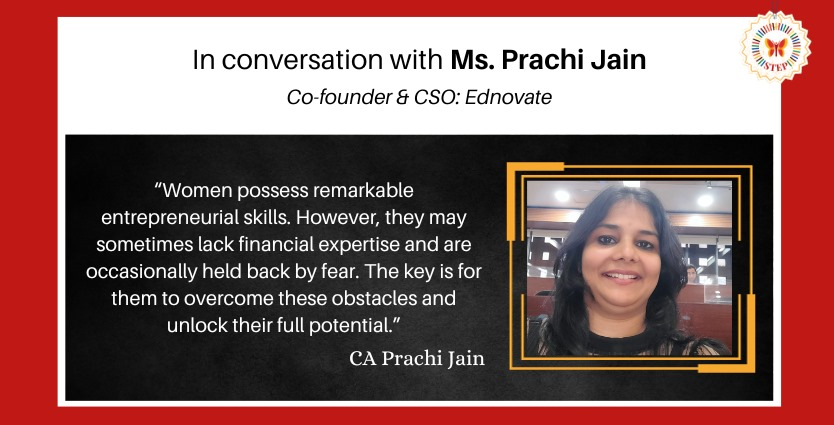
    Women possess remarkable entrepreneurial skills. However, they may sometimes lack financial expertise and are occasionally held back by fear. The key is for them to overcome these obstacles and unlock their full potential,” is her message to women entrepreneurs.

    Prachi, the person

    Motivated by a deep desire to make a positive impact on society and become a better version of herself, Prachi draws inspiration from her parents, Ms.Kiran Bedi, and her seniors – Partha Choudhury and Ashalata Shettigar.

    She prefers hills to beaches. A quote that is the mantra of her life is, “Live life to the fullest. Strive to be a better version of yourself and do not take life too seriously.”

Need Help?