
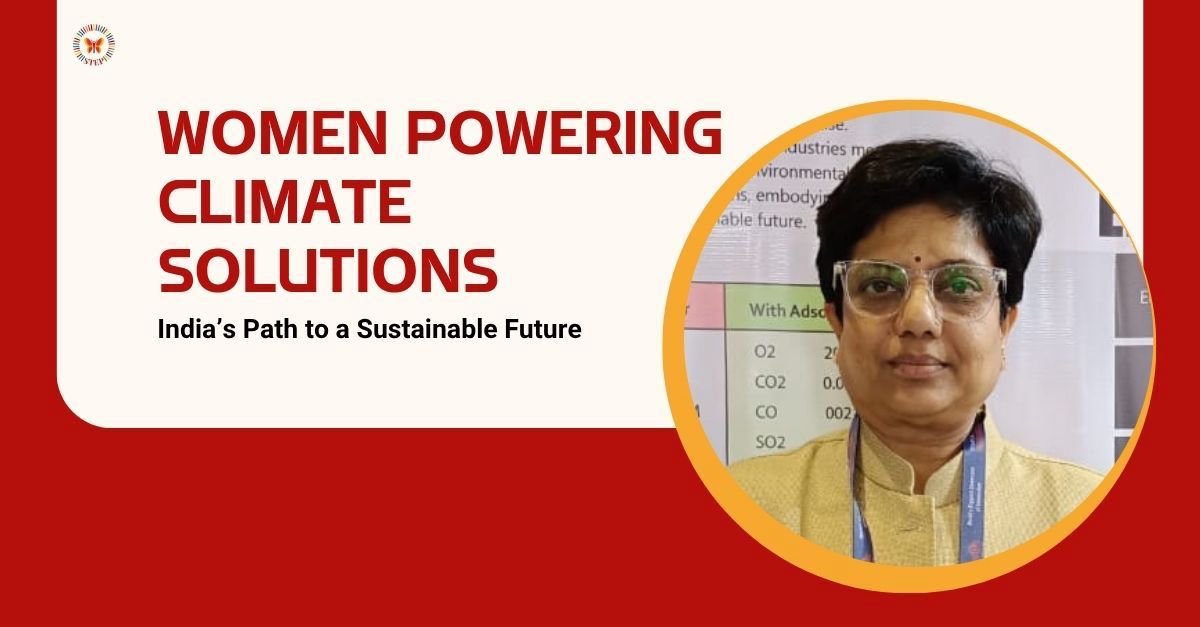
Women Powering Climate Solutions
-
by
amita-admin
STEPper Anjali Puranik, a chemistry professor at Mumbai University, prepared a model for cleaning stack emissions for her children’s school science exhibition using household utensils.
The model involved burning coal in a furnace and circulating the smoke through various particulate matter control devices.
The drop in emissions was truly impressive!
This model, “Vasundarella” (meaning Mother Earth in Marathi), reached a national competition, and the chief guest encouraged her to keep up the research.
That inspired Anjali to study the subject further.
Today, she is building Bhagirath Laboratories, aimed at tackling industrial air pollution.
Instead of letting factories release harmful smoke into the air, her system captures it the moment it’s produced, strips away the dust and particles, washes it clean, and neutralizes dangerous gases. By the time it’s released, the smoke is transformed into much cleaner air – reducing the toxins that cause breathing problems, acid rain, and climate damage.
What started as a school project has transformed into an impactful solution for combating industrial pollution.
This is the power of imagination that women bring to the table.
But her journey was not easy. Despite winning competitions in India and abroad, she could not make much progress.
She received offers for collaborations that she could not take as her children were young and moving from home was not an option. The lack of a “proven market” made it tough to move forward. With no similar product and no business background, gaining investor trust was tough.
Anjali was a part of UnPollute’24. In her words, “The UnPollute Conclave was a transformative experience for us. It helped me refine our pitch deck and data with expert input, and ensured our story and vision were communicated clearly and powerfully. Thanks to their dedication, our proposal reached the right people in the most impactful way. We’re genuinely thankful for their unwavering support.”
Anjali received Startup India Seed Funding through STEP and is using the funds to strengthen the pilot plant, upgrade lab equipment, and increase her visibility.
Anjali’s journey is just one example of how individual innovation and right guidance at the right time can contribute to a cleaner future.
Climate change is not just a statistic; it is a stark reality taking a toll on the Earth. From small island nations battling saltwater intrusion to communities displaced by floods or droughts, millions are already experiencing the fallout, and the numbers will rise. The crisis is not only environmental – it affects our health, homes, jobs, and safety.
While climate change impacts everyone, it doesn’t do so equally. In India and globally, women often carry the heaviest burden, not just as victims of environmental degradation, but as frontline problem-solvers whose knowledge and leadership are vital for building resilience.
Women at the Forefront of Climate Action
Women are Environmental Stewards
- They produce 50% of the world’s food
- Hold invaluable indigenous and ancestral environmental knowledge.
They are the Backbone of Resilience
- Women perform 2.5 times more unpaid care work than men
- Often, the first responders during disasters – rescuing, caring, and rebuilding communities, are women
They are the Agents of Change
- Women influence 70–80% of consumer purchases in wealthier nations, often favoring sustainable products.
- Countries with women in parliament adopt stronger climate policies and ratify more environmental treaties.
- Gender-diverse companies show better climate governance and invest more in renewable energy.
- Women now make up 40% of the solar sector workforce, compared to 22% in oil and gas.
Roadblocks to an Inclusive Green Economy
- Women have less access to a range of resources, from land rights and credit to education and technology.
- They are underrepresented in policy-making on disaster risk and recovery, despite frontline experience.
- Gender bias in lending systems leads to higher rejection rates
- Limited financial literacy
Source: https://www.un.org/en/climatechange/science/climate-issues/women
Towards Gender Parity in India’s Green Economy
- Targeted Policies: Government schemes like term loans up to ₹2 crore for first-time SC and ST women entrepreneurs and the Stand-Up India Scheme are steps in the right direction. Similar schemes should be expanded with simplified online access, and banks should earmark a share of their portfolios for women-led green businesses. State policies like the Maharashtra Startup, Entrepreneurship, and Innovation Policy 2025 also create dedicated funds like the ₹500 crore “Maha-Fund” to support these ventures.
- Grassroots Initiatives: Schemes like the Mahila Coir Yojana support women in eco-friendly industries, while the National Rural Livelihood Mission (NRLM) helps women’s self-help groups (SHGs) pursue green livelihoods, like organic farming and recycling. The Solar Saheli initiative trains rural women to sell solar energy products, fostering both economic independence and sustainability.
- Ensuring Measures for Accountability and Mentorship: Mandating gender audits for green finance schemes is a powerful tool to ensure equitable capital allocation and generate data to shape targeted interventions. This transparency can also serve as a trust signal for impact investors. Additionally, targeted mentorship, role models, and corporate-backed boot camps are essential for scaling women-led ventures. Programs like IIM-Bangalore and Goldman Sachs’ “10,000 Women” provide a proven model.
- Education: With women comprising just 19.2% of engineering graduates in India, scholarships and updated curricula in fields such as automation, renewable energy, and biotechnology are essential. Programs like Tata Steel’s “Women of Mettle” offer a model for how corporations can help.
Source:
thehindu.com/opinion/op-ed/empowering-women-in-green-business/article69656544.ece/amp/
A Call to Action
If India is serious about building a resilient and inclusive green economy by 2047, women must be at its center, not as an afterthought, but as leaders, innovators, and decision-makers. The climate clock is ticking, and the time to act is now.
UnPollute 2025, India’s only conclave dedicated to women entrepreneurs in climate action is back – Bigger, Bolder, and Braver!
Register to participate: https://bit.ly/4pcZSx9
Co-create the blueprint of sustainable progress with us: https://bit.ly/46asnDS
Nominate for Awards:https://lnkd.in/g-aZTWTZ
Registration Fee: Early Bird : ₹3,999 | Standard: ₹4,999
Secure your spot now!
UnPollute ’25 isn’t just a Conclave, it’s a movement to catalyze women-led sustainable ventures and spark real change!!
Here’s your SEO-optimized content set with FAQs separately for easy copy 👇
Focus Keyword:
women powering climate solutions
Primary SEO Keywords:
women in climate change, women climate leaders, women in sustainability, women entrepreneurs climate solutions, green startups by women
Long-Tail Keywords:
how women are solving climate change problems
women led climate startups in India
role of women in environmental sustainability
how women entrepreneurs are building green businesses
examples of women in climate solutions
Meta Description:
Discover how women are powering climate solutions through innovation, sustainability, and entrepreneurship. Learn how women leaders are driving change and building a greener future.
FAQs
1. What does women powering climate solutions mean?
It refers to women leading efforts in sustainability, climate action, and environmental innovation through businesses, initiatives, and community work.
2. How are women contributing to climate solutions?
Women contribute by creating sustainable businesses, promoting eco friendly practices, and leading projects focused on environmental protection.
3. Why are women important in climate change solutions?
Women bring community driven approaches, innovative ideas, and long term sustainability practices that are essential for solving climate challenges.
4. What are examples of women led climate solutions?
Examples include eco friendly product brands, waste management startups, renewable energy initiatives, and sustainable farming led by women.
5. What challenges do women face in climate entrepreneurship?
Women often face limited funding access, lack of networks, and fewer opportunities, which can affect the growth of their climate focused ventures.
6. How can women start a climate focused business?
Women can start by identifying environmental problems, building simple solutions, testing ideas, and scaling with proper guidance and support.
7. How can programs like STEP support women in climate solutions?
Programs like STEP provide mentorship, training, and a supportive ecosystem to help women build and grow sustainability focused businesses.
