Category: Uncategorized

  • How to Find a Business Idea When You Feel Lost

    Feeling lost at the beginning is more common than you think. Many women who are now running successful businesses once sat in the same place, confused, unsure, and overwhelmed with questions like, what should I start, or do I even have the right idea.

    The truth is, you don’t need a perfect idea to start. You need a clear direction.

    Why Feeling Lost Is Actually a Good Sign

    When you feel lost, it usually means one thing, you are ready for change.

    Many women delay starting a business because they think they need a unique idea, feel they lack experience, or are afraid of failure.

    But here is a fact based on government-backed data.

    More than 2.86 crore women-led MSMEs are already operating in India. Around 19.43 percent of registered MSMEs are owned by women.

    This clearly shows that thousands of women started without perfect ideas and built something meaningful.

    Step by Step How to Find a Business Idea That Works

    1. Start With Your Daily Life

    Don’t look outside first, look at your daily routine.

    Ask yourself, what problems you face every day, what tasks feel difficult, or what people ask your help for.

    If something is a problem for you, it is likely a problem for others too, and that can become your business idea.

    Simple rule, problems create opportunities.

    2. Identify Your Skills, Even Small Ones

    You don’t need a professional degree to start.

    Think about skills like cooking, teaching, communication, social media, or organizing things.

    Government programs like PMEGP have already helped more than 1.38 lakh women set up businesses using basic skills and low investment, according to MSME reports.

    This proves that small skills can become real businesses.

    3. Look Around Your Community

    Sometimes, the best ideas are already visible around you.

    Observe what services are missing, what people complain about, and what businesses are working.

    You don’t need to invent something new, you just need to do it better or differently.

    4. Don’t Overthink, Test Quickly

    Many beginners stay stuck because they keep thinking instead of doing.

    Start small, offer your service to a few people, take feedback, and improve.

    Clarity comes from action, not overthinking.

    5. Check If Your Idea Can Make Money

    Before going all in, validate your idea.

    Ask if people will pay for it, if there is demand, and if you can start with low investment.

    Businesses that solve real problems have higher chances of success, especially in India’s MSME ecosystem.

    Quick Idea Framework

    If you feel confused, use this simple formula.

    Problem plus skill plus demand equals a business idea.

    Example, busy families plus cooking skills plus need for healthy food equals a home tiffin business.

    Common Mistakes to Avoid

    Waiting for the perfect idea.
    Comparing yourself with others.
    Thinking you need a lot of money.
    Not taking action.

    Clarity comes after you start, not before.

    How STEP Helps You Move From Confusion to Clarity

    Many women feel stuck not because they lack ideas, but because they lack guidance.

    STEP, Support Training and Empowerment Program, helps you turn confusion into clear action.

    It helps you identify the right business idea based on your skills and situation. You get step by step guidance so you are not lost. You learn practical skills like marketing, sales, and digital basics. You become part of a supportive community of women. Most importantly, you focus on action instead of overthinking.

    STEP believes you already have potential, you just need direction.

    You Are Not Behind, You Are Beginning

    Feeling lost does not mean you are failing. It means you are searching for something better.

    Your idea does not need to be big, it just needs to be real.

    Start small, start simple, start today.

    FAQs

    1. How do I find a business idea when I feel lost

    Start by identifying problems in your daily life, your skills, and what people need, then combine them into a simple idea.

    2. Do I need a unique idea to start a business

    No, you can start with an existing idea and improve it or serve a specific audience better.

    3. What is the easiest business to start for women

    Home based businesses like tiffin services, freelancing, online selling, and teaching are easy to start.

    4. How can I know if my business idea will work

    Test it with a small group, get feedback, and see if people are willing to pay.

    5. Can I start a business with no experience

    Yes, many women start without experience by learning and taking small steps.

    6. What are common mistakes beginners make

    Overthinking, waiting for perfect ideas, and not taking action.

    7. How can STEP help me find the right business idea

    STEP provides guidance, training, and support to help you identify, validate, and start your business with confident.
  • Dreams Don’t Expire After Marriage or Motherhood

    A New Beginning for Women Entrepreneurs in India

    For generations, women have been told sometimes directly, often silently that marriage or motherhood marks the end of their dreams. But today, that narrative is changing. Across India, women are rewriting their stories, proving that dreams don’t expire, they evolve.

    The Rise of Women Entrepreneurs in India

    India is witnessing a powerful shift women are no longer just participants in the economy; they are becoming leaders of change.

    Over 2.86 crore women-led MSMEs are now active in India, showing massive growth. Around 19.43% of registered MSMEs are owned by women. In some datasets, up to 39% of enterprises are women-owned. Women-led businesses are contributing significantly to GDP and employment generation in India’s MSME sector.

    The government has also emphasized “women-led development” as a key growth strategy for India’s future. This is not just progress, it’s a movement.

    Marriage and Motherhood: Not Barriers, But Strengths

    Marriage and motherhood are often seen as interruptions, but in reality, they build powerful entrepreneurial skills.

    Women develop strong time management by balancing home and responsibilities. They gain emotional intelligence by understanding people deeply. They become resilient by handling pressure and uncertainty. Everyday life strengthens their problem-solving ability.

    These are the same qualities that define successful entrepreneurs.

    Many women start businesses after motherhood because they seek financial independence, want flexible work, and wish to create something of their own. Increasingly, they are succeeding.

    Real Growth Stories: Women Changing India

    Across India, women are building businesses in every sector from rural enterprises to modern startups.

    Women-led dairy businesses in Uttar Pradesh generate thousands of crores in revenue and support large communities. Thousands of women-led startups are actively growing across different states, showing that entrepreneurship among women is no longer rare, it is rising rapidly.

    Challenges Women Still Face (And How to Overcome Them)

    Women entrepreneurs still face challenges, but each challenge has a practical solution.

    Access to funding remains a major hurdle, as women often face a higher credit gap compared to men. Starting small, building proof of concept, and using government-backed financial schemes can help overcome this.

    Lack of support or networks is another challenge. Many women do not have access to mentors or business communities. Joining entrepreneurial networks and learning from others can make a big difference.

    Social conditioning also plays a role, where women hesitate to take risks due to societal expectations. The shift needed here is internal, moving from seeking permission to taking ownership.

    Government Support for Women Entrepreneurs

    The Indian government is actively supporting women entrepreneurs through various initiatives.

    Programs like Udyam Sakhi provide training and mentorship. Mudra Yojana offers collateral-free loans. Stand-Up India supports women in starting enterprises. PMEGP provides subsidies that make starting a business more affordable.

    These initiatives are designed to help women move from ideas to execution.

    Why This Is the Best Time to Start

    There has never been a better time for women to start a business.

    Digital tools have made it easier to launch and run businesses from home. Social media allows low-cost marketing and direct customer access. Flexible work models are widely accepted. Support systems and awareness are growing. Most importantly, the mindset is changing.

    How STEP Can Help Women Entrepreneurs

    STEP is built to help women turn their ideas into sustainable businesses.

    It provides skill development in areas like marketing, sales, and digital tools. Women receive mentorship and practical guidance to avoid common mistakes. The community offers support, motivation, and collaboration opportunities.

    STEP also helps women move from idea to execution by guiding them through the process of starting and growing a business. Beyond skills, it focuses on building confidence, which is often the biggest barrier. STEP believes that women do not lack talent—they need the right support system.

    Your Dreams Are Still Valid

    Marriage did not cancel your dreams. Motherhood did not end your ambitions. It only added new meaning to them.

    You are not late. You are not behind. You are starting with more strength, experience, and clarity than ever before.

    FAQs

    1. Can I start a business after marriage or kids?

    Yes, many successful women start their businesses after marriage or motherhood because they seek flexibility and purpose.

    2. What are the best business ideas for women at home?

    Online businesses, freelancing, home-based services, boutiques, digital marketing, and consulting are great options.

    3. Do I need a lot of money to start a business?

    No, many businesses today can be started with low investment using digital platforms.

    4. Which government schemes support women entrepreneurs in India?

    Schemes like Mudra Yojana, Stand-Up India, PMEGP, and Udyam Sakhi provide financial and training support.

    5. How can I manage business with family responsibilities?

    Start small, create a flexible schedule, and scale gradually as you gain stability.

    6. What skills are important for women entrepreneurs?

    Communication, marketing, financial understanding, and digital skills are essential.

    7. How can STEP help me start my business?

    STEP provides training, mentorship, and a supportive community to help women confidently start and grow their businesses.

    Final Thought

    India does not just need more businesses. It needs more women-led businesses.

    When a woman builds a business, she does not just change her own life—she creates opportunities, inspires others, and transforms future generations.

  • Why Most Startups Fail: Mistakes Every New Founder Must Know

    India is one of the fastest-growing startup ecosystems in the world, with over 2 lakh recognized startups and millions of jobs created. Yet, behind this growth lies a hard truth: most startups don’t survive.

    Studies suggest that nearly 65–90% of startups fail within the first five years. And in India, even with rising opportunities, founders—especially women—face additional structural challenges like funding gaps, lack of mentorship, and limited access to networks.

    Latest Insights from India’s Startup Ecosystem

    • Women founders receive only ₹4 out of every ₹100 in startup funding
    • Nearly 75% of women-led startups remain unfunded
    • Despite this, women-led businesses are growing rapidly across India, including smaller cities
    • Government and industry bodies emphasize training, mentorship, and awareness as key success drivers

    This shows one clear thing: failure is not just about bad ideas—it’s often about lack of support, strategy, and execution.

    Top Mistakes That Cause Startup Failure

    1. Building Something Nobody Wants

    The biggest mistake founders make is not validating their idea.

    Research shows that 42% of startups fail due to lack of market demand.

    Many founders fall in love with their idea instead of solving a real problem.

    Fix:

    • Talk to real users
    • Test before investing
    • Start small

    2. Poor Financial Management

    Running out of money is one of the fastest ways to fail.

    29% of startups fail due to cash flow issues. Many founders overspend on branding, tech, or offices too early.

    For women founders, this becomes even harder due to funding gaps.

    Reality: Women in India receive only a small fraction of total funding.

    Fix:

    • Start lean
    • Focus on revenue early
    • Track every expense

    3. Lack of Business Knowledge & Guidance

    Many first-time founders start with passion but no strategy.

    Common gaps include no business model, no pricing strategy, and no growth plan. This is where most startups struggle silently.

    Experts emphasize that capacity building and mentorship are critical for startup success.

    4. Ignoring Customers & Feedback

    Some founders focus more on social media presence, branding, or growth hacks instead of solving customer problems.

    Real growth comes from customer satisfaction, not just marketing.

    Fix:

    • Listen to feedback
    • Improve continuously
    • Build trust, not just reach

    5. Trying to Do Everything Alone

    This is one of the most common mistakes, especially among women founders.

    Reasons include lack of support, fear of asking for help, and limited access to networks. But entrepreneurship is not a solo journey.

    Even today, women face network exclusion and fewer opportunities in startup ecosystems.

    6. Lack of the Right Ecosystem

    A strong ecosystem includes mentors, community, skill-building, and business exposure.

    Without this, founders make avoidable mistakes, lose confidence, and struggle to scale.

    This is one of the biggest hidden reasons why startups fail.

    Why Women Founders Face More Challenges

    Even though women contribute significantly to the economy:

    • Around 20% of MSMEs in India are owned by women
    • Women-led businesses generate millions of jobs

    Still, challenges remain:

    • Limited funding access
    • Social expectations
    • Lack of mentorship
    • Confidence gaps

    This doesn’t mean women fail more—it means they are not supported enough to succeed.

    How the Right Support Can Change Everything

    This is where platforms like STEP (Sustainable, Transformative, Empowering Programs) play a crucial role.

    They help founders by providing:

    Skill Development
    Learn how to build, validate, and scale a business

    Mentorship & Guidance
    Avoid costly beginner mistakes

    Community Support
    Connect with like-minded women entrepreneurs

    Business Growth Framework
    Turn ideas into sustainable income

    Instead of struggling alone, founders get direction, clarity, and confidence.

    Final Thoughts

    Startups don’t fail because people aren’t capable. They fail because ideas aren’t validated, money isn’t managed, and support systems are missing.

    For women, the journey may be harder but also more powerful.

    With the right mindset, strategy, and ecosystem, failure is not the end—it’s just a lesson.

    And with the right support from platforms like STEP (Sustainable, Transformative, Empowering Programs), first-time founders can avoid common mistakes and build something truly meaningful.

    FAQs

    1. Why do most startups fail?

    Most startups fail due to lack of market demand, poor financial management, and lack of proper planning or mentorship.

    2. What is the biggest mistake new founders make?

    The biggest mistake is building a product or service without validating if people actually need it.

    3. How can first-time founders avoid failure?

    They can validate ideas, manage finances carefully, seek mentorship, and focus on solving real customer problems.

    4. Why do women-led startups face more challenges?

    Women often face funding gaps, limited networks, and societal barriers, which affect their business growth.

    5. How important is mentorship in startups?

    Mentorship helps founders avoid mistakes, gain clarity, and make better business decisions.

    6. What percentage of startups fail in India?

    Estimates suggest that around 65–90% of startups fail within the first few years.

    7. How can platforms like STEP help new founders?

    Programs like STEP (Sustainable, Transformative, Empowering Programs) provide training, mentorship, and community support to help founders succeed.


  • Women Powering Climate Solutions

    Women Powering Climate Solutions

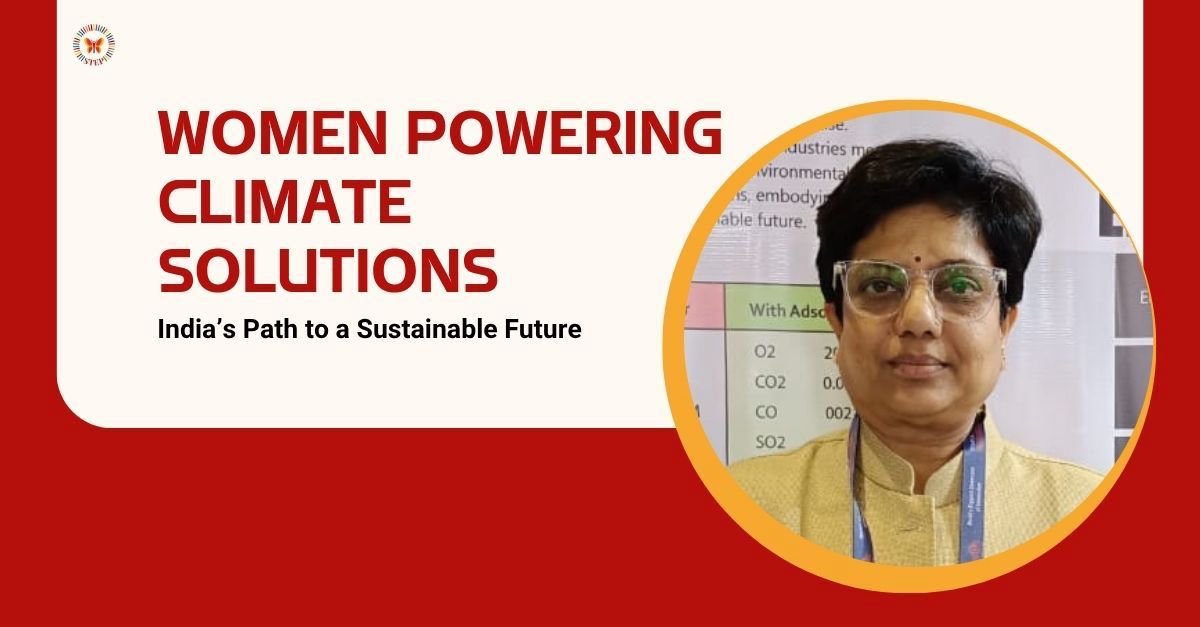
    STEPper Anjali Puranik, a chemistry professor at Mumbai University, prepared a model for cleaning stack emissions for her children’s school science exhibition using household utensils.  

    The model involved burning coal in a furnace and circulating the smoke through various particulate matter control devices.  

    The drop in emissions was truly impressive! 

    This model, “Vasundarella” (meaning Mother Earth in Marathi), reached a national competition, and the chief guest encouraged her to keep up the research. 

    That inspired Anjali to study the subject further. 

    Today, she is building Bhagirath Laboratories, aimed at tackling industrial air pollution. 

    Instead of letting factories release harmful smoke into the air, her system captures it the moment it’s produced, strips away the dust and particles, washes it clean, and neutralizes dangerous gases. By the time it’s released, the smoke is transformed into much cleaner air – reducing the toxins that cause breathing problems, acid rain, and climate damage. 

    What started as a school project has transformed into an impactful solution for combating industrial pollution. 

    This is the power of imagination that women bring to the table. 

    But her journey was not easy. Despite winning competitions in India and abroad, she could not make much progress.  

    She received offers for collaborations that she could not take as her children were young and moving from home was not an option. The lack of a “proven market” made it tough to move forward. With no similar product and no business background, gaining investor trust was tough.  

    Anjali was a part of UnPollute’24. In her words, “The UnPollute Conclave was a transformative experience for us. It helped me refine our pitch deck and data with expert input, and ensured our story and vision were communicated clearly and powerfully. Thanks to their dedication, our proposal reached the right people in the most impactful way. We’re genuinely thankful for their unwavering support.”   

    Anjali received Startup India Seed Funding through STEP and is using the funds to strengthen the pilot plant, upgrade lab equipment, and increase her visibility. 

    Anjali’s journey is just one example of how individual innovation and right guidance at the right time can contribute to a cleaner future.  

    Climate change is not just a statistic; it is a stark reality taking a toll on the Earth. From small island nations battling saltwater intrusion to communities displaced by floods or droughts, millions are already experiencing the fallout, and the numbers will rise. The crisis is not only environmental – it affects our health, homes, jobs, and safety. 

    While climate change impacts everyone, it doesn’t do so equally. In India and globally, women often carry the heaviest burden, not just as victims of environmental degradation, but as frontline problem-solvers whose knowledge and leadership are vital for building resilience. 

    Women at the Forefront of Climate Action 

    Women are Environmental Stewards 

    • They produce 50% of the world’s food  
    • Hold invaluable indigenous and ancestral environmental knowledge
       

    They are the Backbone of Resilience 

    • Women perform 2.5 times more unpaid care work than men 
    • Often, the first responders during disasters – rescuing, caring, and rebuilding communities, are women 
       

     They are the Agents of Change 

    • Women influence 70–80% of consumer purchases in wealthier nations, often favoring sustainable products. 
    • Countries with women in parliament adopt stronger climate policies and ratify more environmental treaties. 
    • Gender-diverse companies show better climate governance and invest more in renewable energy. 
    • Women now make up 40% of the solar sector workforce, compared to 22% in oil and gas. 

    Roadblocks to an Inclusive Green Economy 

    • Women have less access to a range of resources, from land rights and credit to education and technology. 
    • They are underrepresented in policy-making on disaster risk and recovery, despite frontline experience. 
    • Gender bias in lending systems leads to higher rejection rates 
    • Limited financial literacy 

    Source: https://www.un.org/en/climatechange/science/climate-issues/women 

    Towards Gender Parity in India’s Green Economy 

    • Targeted Policies: Government schemes like term loans up to ₹2 crore for first-time SC and ST women entrepreneurs and the Stand-Up India Scheme are steps in the right direction. Similar schemes should be expanded with simplified online access, and banks should earmark a share of their portfolios for women-led green businesses. State policies like the Maharashtra Startup, Entrepreneurship, and Innovation Policy 2025 also create dedicated funds like the ₹500 crore “Maha-Fund” to support these ventures. 
    • Grassroots Initiatives: Schemes like the Mahila Coir Yojana support women in eco-friendly industries, while the National Rural Livelihood Mission (NRLM) helps women’s self-help groups (SHGs) pursue green livelihoods, like organic farming and recycling. The Solar Saheli initiative trains rural women to sell solar energy products, fostering both economic independence and sustainability. 
    • Ensuring Measures for Accountability and Mentorship: Mandating gender audits for green finance schemes is a powerful tool to ensure equitable capital allocation and generate data to shape targeted interventions. This transparency can also serve as a trust signal for impact investors. Additionally, targeted mentorship, role models, and corporate-backed boot camps are essential for scaling women-led ventures. Programs like IIM-Bangalore and Goldman Sachs’ “10,000 Women” provide a proven model. 
    • Education: With women comprising just 19.2% of engineering graduates in India, scholarships and updated curricula in fields such as automation, renewable energy, and biotechnology are essential. Programs like Tata Steel’s “Women of Mettle” offer a model for how corporations can help. 

    Source: 

    thehindu.com/opinion/op-ed/empowering-women-in-green-business/article69656544.ece/amp/ 

    A Call to Action 

    If India is serious about building a resilient and inclusive green economy by 2047, women must be at its center, not as an afterthought, but as leaders, innovators, and decision-makers. The climate clock is ticking, and the time to act is now.  

    UnPollute 2025, India’s only conclave dedicated to women entrepreneurs in climate action is back – Bigger, Bolder, and Braver! 

    Register to participate: https://bit.ly/4pcZSx9 

     Co-create the blueprint of sustainable progress with us: https://bit.ly/46asnDS 

     Nominate for Awards:https://lnkd.in/g-aZTWTZ 

     Registration Fee: Early Bird : ₹3,999 | Standard: ₹4,999 

    Secure your spot now! 

     UnPollute ’25 isn’t just a Conclave, it’s a movement to catalyze women-led sustainable ventures and spark real change!! 

    Here’s your SEO-optimized content set with FAQs separately for easy copy 👇


    Focus Keyword:

    women powering climate solutions

    Primary SEO Keywords:

    women in climate change, women climate leaders, women in sustainability, women entrepreneurs climate solutions, green startups by women

    Long-Tail Keywords:

    how women are solving climate change problems
    women led climate startups in India
    role of women in environmental sustainability
    how women entrepreneurs are building green businesses
    examples of women in climate solutions


    Meta Description:

    Discover how women are powering climate solutions through innovation, sustainability, and entrepreneurship. Learn how women leaders are driving change and building a greener future.


    FAQs

    1. What does women powering climate solutions mean?

    It refers to women leading efforts in sustainability, climate action, and environmental innovation through businesses, initiatives, and community work.

    2. How are women contributing to climate solutions?

    Women contribute by creating sustainable businesses, promoting eco friendly practices, and leading projects focused on environmental protection.

    3. Why are women important in climate change solutions?

    Women bring community driven approaches, innovative ideas, and long term sustainability practices that are essential for solving climate challenges.

    4. What are examples of women led climate solutions?

    Examples include eco friendly product brands, waste management startups, renewable energy initiatives, and sustainable farming led by women.

    5. What challenges do women face in climate entrepreneurship?

    Women often face limited funding access, lack of networks, and fewer opportunities, which can affect the growth of their climate focused ventures.

    6. How can women start a climate focused business?

    Women can start by identifying environmental problems, building simple solutions, testing ideas, and scaling with proper guidance and support.

    7. How can programs like STEP support women in climate solutions?

    Programs like STEP provide mentorship, training, and a supportive ecosystem to help women build and grow sustainability focused businesses.

  • Nurturing Green Innovation- How Incubators Are Fueling Sustainability-Focused Startups in India

    Nurturing Green Innovation- How Incubators Are Fueling Sustainability-Focused Startups in India

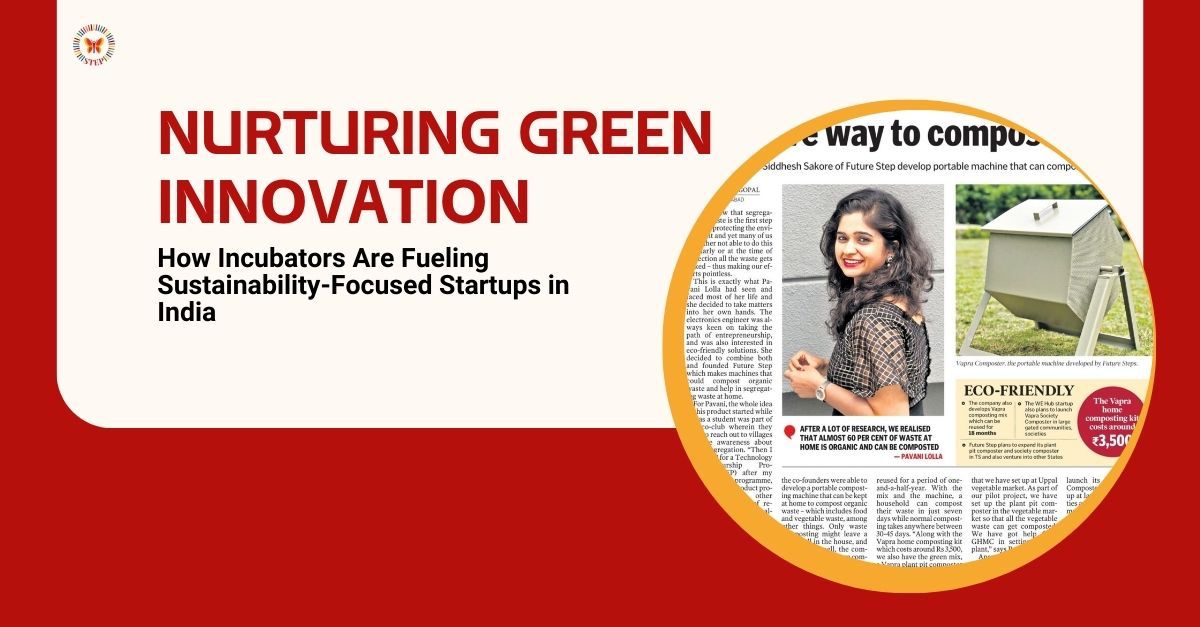
    Pavni Lolla never imagined her science project would transform into a movement. As a student with no business background, she saw a problem – India’s 150,000 metric tons of daily organic waste and tinkered with a solution: the Vapra home composter, a device that turns kitchen scraps into rich compost in just seven days. 

    Like most first-time founders, she hit a wall. 

    “I knew how to compost, but not how to sell it,” Pavni admits. 

    That’s where STEP stepped in. With mentorship on storytelling, pricing, and customer outreach, Vapra found its momentum. Today, 13,500 families use her composters, preventing 120,000 kgs of waste every single day. 

    Pavni’s story is more than a success. It’s a blueprint for how incubators bridge the gap between passion and scalable impact. 

    The Bigger Picture: India’s Sustainability Startup Boom 

    India’s climate-tech ecosystem is buzzing. Over 600+ startups are registered under Startup India across sectors such as: 

    • Waste management 
    • Renewable energy (solar, hydrogen) 
    • Circular economy (upcycling textiles, plastics) 
    • Water conservation 
    • Sustainable fashion 

    But growth isn’t without hurdles. 

    • 39% of these startups are women-led, yet only 10% secure Series A funding (Inc42, 2023). 
    • Nearly half come from Tier 2/3 cities, where access to capital, mentorship, and investor networks is thin. 

    For founders like Pavni, this often means brilliance without the bridge. 

    Why Investors Often Shy Away 

    If climate-tech is the future, why is it still underfunded? 

    Think of it this way: while a fintech app may scale in months, a green startup often feels like planting a mango tree – you nurture it today, but the fruits arrive years later. 

    Here’s what makes investors hesitate: 

    • High Capital Needs, Slow Returns – Many ventures need 5 – 6x more upfront investment and take 7+ years to break even. 
    • The “Green Premium” Problem – Consumers may not pay extra for sustainable options in cost-sensitive markets. 
    • Regulatory Uncertainty – Policies evolve, but clear incentives and tax breaks remain limited. 
    • Exit Challenges – Asset-heavy, long-horizon businesses make valuations and exits tricky. 
    • Behavioral Barriers – Even good tech struggles if consumers don’t trust or adopt it quickly. 

    How Incubators Fill the Gap 

    • Mentorship & Guidance – Shaping business models for both sustainability and profitability. 
    • Funding & Grants – Unlocking CSR, government, and impact capital. 
    • Networking & Partnerships – Connecting startups with corporates, NGOs, and researchers. 
    • Tech & Infrastructure – Labs, testing facilities, and R&D support. 
    • Gender-Inclusive Leadership – Training women founders to break cultural biases and access markets. 

    As STEP Founder, Ms. Reinu Shah, puts it: 

    Women are disproportionately affected by climate change, yet are often excluded from leading the solutions. At STEP, we don’t just empower women with skills and networks – we enable them to transition from beneficiaries to change agents in climate action.” 

    If Vapra is about household change, Farmers for Forests (F4F) is about community power. 

    When Arti Dhar co-founded F4F, a hybrid enterprise incentivizing rural communities to protect forests, she faced a double challenge: 

    • Funding gaps – blending philanthropy, carbon credits, and agroforestry. 
    • Operational complexity – running teams across remote, infrastructure-poor regions. 

    Through STEP’s mentorship, Arti’s team honed risk management, financial modeling, and fundraising narratives. 

    Five years later, the results speak for themselves: 

    🌳 200,000 hectares of forests protected 

    🌍 40 million kgs of CO₂ sequestered annually (equal to removing 8,700 cars from the road) 

    👩‍🌾 35,000+ man-days of rural employment created 

    The Incubator Imperative 

    India’s sustainability revolution won’t be won by ideas alone. Pavni’s composters and Arti’s forests show us this: the bridge between innovation and impact is incubation. 

    Incubators do what markets alone cannot: 

    • Democratize access through networks and mentors 
    • De-risk innovation with blended finance and policy navigation 
    • Amplify marginalized voices, ensuring women lead climate action 

    The numbers tell the story, but the real metric is this: every incubated startup that survives proves sustainability isn’t a niche – it’s the next trillion-dollar economy. 

    As India races toward its net-zero ambitions, incubators aren’t just supporting founders. They’re rewriting the rules of business – where profit and planet thrive together. 

    Join the Movement 

    If you’re a green entrepreneur building sustainable solutions, or an industry expert, mentor, or investor eager to co-create impact, applications for UnPollute’25  are now open. 

    🌱 The Incubation Program: Are you a woman-led startup building solutions for a cleaner planet? Apply for our incubation program. Get access to capacity building workshops, mentorship, funding connections, and the tools to scale your impact. Apply NOW!! 

    https://docs.google.com/forms/d/e/1FAIpQLSd_KhRARiY9uBsld2_LAEloTI_3-MRNKyYR2NIMo62vbBnxBQ/viewform?usp=dialog

    🤝 2. Co-Create at UnPollute ’25 We’re calling all industry experts, incubators, mentors, and investors! Lend your expertise to shape the future. Collaborate on workshops, mentor startups, or design a roundtable. Let’s co-create the blueprint for sustainable innovation. Join the Inner Circle:  

    https://docs.google.com/forms/d/e/1FAIpQLSd2s1s8fujGaMNNLBCynfXIt-iuVCbYqxtgEPa58M8uBqUcgA/viewform?usp=dialog

    To know more: 

    https://thestepworld.com/unpollute25/

    Here’s your SEO-optimized set with FAQs separated for easy copy 👇


    Focus Keyword:

    green innovation incubators in India

    Primary SEO Keywords:

    sustainability startups India, startup incubators India, green startups India, climate tech startups India, incubators for startups India

    Long-Tail Keywords:

    how incubators support sustainability startups in India
    green innovation startup ecosystem India
    role of incubators in climate startups
    how to start a sustainability startup in India
    support for green startups in India incubators


    Meta Description:

    Explore how incubators in India are nurturing green innovation and supporting sustainability focused startups with funding, mentorship, and resources to build a greener future.


    FAQs

    1. What are green innovation incubators?

    Green innovation incubators are programs that support startups working on sustainability and environmental solutions by providing mentorship, funding, and resources.

    2. How do incubators support sustainability focused startups in India?

    Incubators support startups through mentorship, funding access, networking, and guidance to help them build and scale sustainable solutions.

    3. Why are incubators important for green startups?

    Incubators help reduce risks by providing support, knowledge, and connections, which are essential for early stage sustainability startups.

    4. What types of sustainability startups are supported by incubators?

    They support startups in areas like renewable energy, waste management, eco friendly products, climate tech, and sustainable agriculture.

    5. Are there government programs supporting green startups in India?

    Yes, government initiatives support sustainability startups through funding, incubation programs, and schemes that promote innovation and environmental solutions.

    6. How can a startup join an incubator in India?

    Startups can apply through incubator websites, startup platforms, or government portals by submitting their idea, business model, and growth plan.

    7. How do incubators help women entrepreneurs in sustainability?

    Incubators provide women entrepreneurs with mentorship, funding opportunities, and a supportive ecosystem to build and grow sustainable businesses.

  • Building Systems That Empower: How Policy Can Unlock Women’s Entrepreneurship in India

    Building Systems That Empower: How Policy Can Unlock Women’s Entrepreneurship in India

    Real change doesn’t happen by chance—it happens by design. Two models, one in India and one from Rwanda, show us the significance of structured policy frameworks in driving long-lasting, meaningful impact. Also, their effectiveness increases manifold through robust implementation strategies, transparent governance, and active engagement of key stakeholders, including the target audience.   

    The Kudumbashree program was launched 25 years ago by the Left Democratic Front government in Kerala as part of the state’s Poverty Eradication Mission. While the state had strong educational and health foundations, women continued to face patriarchal attitudes, gender based crimes, and poor working conditions. The first step was to ensure women’s participation in Gram Sabhas, which increased from 5% (1996) to 90% through targeted inclusion efforts.

    Initially, Kudumbashree women started with small-scale activities like making soap and pickles. Over time, training programs helped establish over 30,000 micro-enterprises. A key shift occurred when they moved into farming. Today, Joint Liability Groups (JLGs) cultivate over 50,000 hectares, supported by low-interest loans, subsidies, and government-backed training.

     The Kerala Chicken initiative is a standout success—a cooperative venture led by Kudumbashree, which recorded a profit of ₹100 crore last year. 

    The LPG distribution scheme by the Indian Government initially faced skepticism, as it seemed unlikely to shift entrenched firewood-based cooking habits. Yet, over time, it successfully promoted cleaner fuel use, improved women’s health, reduced indoor pollution, and eased the burden of gendered household labor.

    When policies are persistent, inclusive, and grounded in reality, their long-term impact can be transformative, even if results take time.

    Rwanda’s transformation into a global leader in gender equality demonstrates how intentional policy design—rooted in local needs, strong governance, and accountability—can dismantle systemic disparities.

    These examples prove that inequality shrinks not with time, but with deliberate action. For India, these models offer a roadmap to empower women entrepreneurs at scale.

    India’s Progress in Gender Inclusive Entrepreneurship: Persistent Gaps Remain

    India’s journey, though progressing, still faces systemic hurdles. According to NITI Aayog, India is home to 13.5 million women-led enterprises out of a total of 63 million. Yet, women remain vastly underrepresented in the workforce. If this gap were even partially bridged, an estimated 55 million additional women could join the workforce by 2030, providing a powerful boost to India’s ambition of becoming a $5 trillion economy.

    Over 90% of women-led businesses are micro-enterprises that stay micro due to critical design flaws: 

    • Weak business models
    • No access to market research, tech, or branding
    • Fragile supply chains and seasonal revenues
    • Lack of capital, mentorship, and mobility support

    Add to that the underrepresentation in decision-making, limited autonomy, and persistent gender norms, and it’s clear that we’re only scratching the surface.

    What Women Entrepreneurs Are Telling Us: Insights from STEP’s Work

    At STEP, after five years of working closely with women entrepreneurs, one truth has become clear: while passion and innovation are abundant, the systems meant to support them often fall short. Beyond social norms,  the structural barriers — in funding, approvals, compliance, and growth support continue to limit their journeys.

    For example, our flagship program, UnPollute’24,  dedicated to women-led sustainability enterprises, brought forward urgent calls for action.

    They asked for:

    • Tailored mentorship, funding, and networking programs for women in sustainability.
    • Faster approval processes for breakthrough technologies.
    • Government tenders that prioritize sustainable, nature-based solutions to drive market demand
    • More R&D funding to scale green tech innovations
    • Easier access to international markets.
    • Simplified compliance for GST, licensing, and patents.
    • Tax breaks and grants tailored for the funding challenges of sustainability enterprises.
    • Enable startup collaborations with cities and industries to implement green solutions
    • Access to government datasets to drive better research, innovation, and problem-solving.

    Also, as an SISFS-recognized incubator, we regularly engage with women entrepreneurs seeking initial seed funding. Some of the key challenges they have highlighted include:

    • Rigid eligibility criteria set by financial institutions limit access to capital.
    • Lack of upfront capital support needed for R&D and technology development.
    • Funding is contingent on proof of concept, which is hard to achieve without initial financial backing.
    • High costs of manpower, raw materials, and collaborations before funding can be secured.
    • Challenges in scaling technology-based solutions due to a lack of resources at the early stages.
    • Hesitation from financial institutions to back new, disruptive technologies due to perceived risks

    Government Initiatives: Noticeable Steps Taken So Far

    The Indian government has launched several initiatives to provide financial assistance, mentorship, and a supportive ecosystem.

    Launched in 2016, the Stand-Up India Scheme empowers women, SC, and ST entrepreneurs with bank loans (₹10 lakh–₹1 crore) for greenfield ventures. Between 2018–2024, women-led accounts under the scheme grew by 243%, with sanctioned amounts surging 253%, from ₹12,452 crore to ₹43,984 crore.

    The Pradhan Mantri MUDRA Yojana (PMMY), launched in 2015, provides loans up to ₹10 lakh to small and micro enterprises, with a significant number of women benefiting. To date, it has disbursed 52 crore loans totaling ₹32.61 lakh crore, showcasing its extensive impact.

    The Startup India Initiative (2016) has fostered a supportive ecosystem for all startups, including women-led ventures, through tax benefits, funding, and incubation support. Notably, 48% of recognized startups now have at least one woman director (as of Jan 2025).

    Beyond funding, initiatives like NITI Aayog’s Women Entrepreneurship Platform (WEP) build ecosystems—connecting 34,000+ women entrepreneurs to mentorship, networks, and growth opportunities since 2017.

    Older schemes like Stree Shakti Yojana (2000), Cent Kalyani, and Udyogini continue supporting women entrepreneurs through loan concessions (up to ₹1 crore), collateral-free financing, and lower interest rates for low-income applicants.

    Recommendations: Bridging Policy and Practice – The Role of Incubators

    While the government has taken important steps to support women entrepreneurs, much of the ecosystem is still in its early stages of evolution. Many flagship schemes were launched nearly a decade ago, and although their impact is beginning to show, greater momentum is needed.

    There’s a pressing need to raise awareness about these initiatives, especially among women in rural areas, small towns, and emerging sectors like sustainability. Simplifying application processes is equally important, as complex procedures often discourage deserving entrepreneurs from seeking support.

    Incubators can play a pivotal role in bridging the gap between policy and women’s entrepreneurship. By serving as trusted intermediaries, they can help women navigate government programs more effectively, build stronger enterprises, and drive the next wave of inclusive economic growth.

    Empowering women entrepreneurs at scale isn’t just about designing good policies—it’s about ensuring that those policies reach, uplift, and enable women to lead India’s future.

    FAQs

    1. What is the role of policy in women entrepreneurship in India?

    Policies help create opportunities by providing funding support, training programs, and easier access to resources for women entrepreneurs.

    2. What government schemes support women entrepreneurs in India?

    Schemes like Mudra Yojana, Stand Up India, and Startup India provide financial support and guidance to women starting businesses.

    3. What challenges do women entrepreneurs face in India?

    Common challenges include limited access to funding, lack of networks, social barriers, and limited awareness of opportunities.

    4. How can policy improve women entrepreneurship in India?

    Policies can improve access to funding, simplify regulations, provide training, and create supportive ecosystems for women led businesses.

    5. Why is supporting women entrepreneurs important for India?

    Women entrepreneurs contribute to economic growth, job creation, and innovation, making them essential for national development.

    6. How can women access government support for startups?

    Women can apply through official portals, banks, and incubation programs by submitting their business plans and eligibility details.

    7. How can programs like STEP support women entrepreneurs?

    Programs like STEP provide mentorship, training, and community support to help women start and grow their businesses successfully.

Need Help?