Category: Uncategorized

  • How STEP’s Women-Led Startups Stole the Show at Startup Mahakumbh 2025

    How STEP’s Women-Led Startups Stole the Show at Startup Mahakumbh 2025

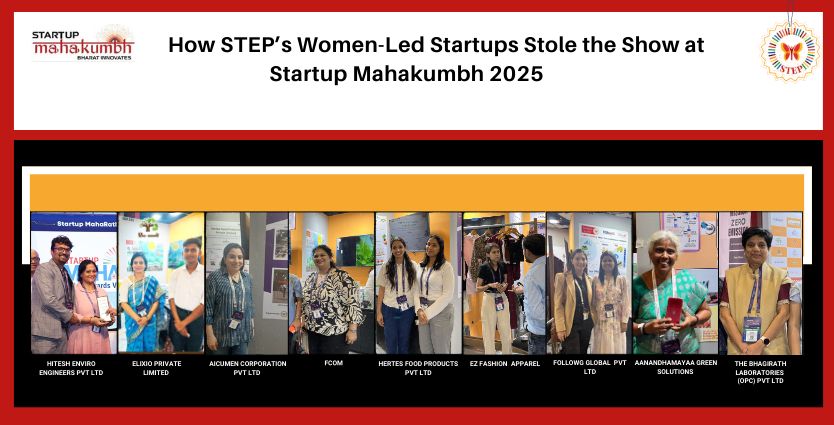
    Amidst the buzz of Hall No. 5 at Startup Mahakumbh 2025, Pod No. 183 was hard to miss—surrounded by a vibrant cluster of nine STEP-supported women-led startups, each charting their own course. These founders collectively brought alive STEP’s vision of a collaborative, empathetic, and thriving ecosystem for women innovators. 

    This year’s Mahakumbh saw over 3,000 startups pitching across 11 key sectors—from D2C and DeepTech to Fintech and SportsTech—each space brimming with next-gen ideas. 

    For STEP, Startup Mahakumbh provided our cohort a powerful platform to showcase ideas, connect with investors, forge partnerships, and gain insights from sector leaders. It was a chance to place women founders firmly at the heart of India’s largest startup gathering. 

    Touted as one of India’s largest startup showcases, the three-day event, supported by the Department for Promotion of Industry and Internal Trade (DPIIT), was a vibrant microcosm of the entire startup ecosystem, bringing together global leaders, government bodies, mentors, students, private sector enablers, and, of course, startups themselves. From policymakers to venture capitalists, incubators to innovators, the event showcased the power of collaboration across all fronts to drive India’s entrepreneurial future.

    “The main purpose of Startup India and Startup Mahakumbh is to facilitate the journey of startups.”
    — Sh. Sanjiv Singh, Joint Secretary, DPIIT

    “Startup Mahakumbh is the physical embodiment of India’s vibrant startup ecosystem. Its vision is to grow as a powerful enabler, showcasing the best innovations, ideas, and entrepreneurs the ecosystem has to offer.
    — Archana Jahagirdar, Founder & Managing Partner, Rukam Capital

    But what truly made it unforgettable were the stories, conversations, and milestones our founders carried back.

    The STEP Cohort: Showcasing Purpose-Driven Startups

    The STEP cohort made a strong mark at Startup Mahakumbh 2025, showcasing innovations across sectors—from fashion tech and AI to clean water solutions and sustainable agriculture.

    • Rhapso Fashion Tech India Pvt Ltd – Offers convenient online and doorstep tailoring services for men, women, and children.
    • The Bhagirath Laboratories (OPC) Pvt Ltd – Manufactures innovative air pollution control devices for industrial air quality management.
    • Hitesh Enviro Engineers Pvt Ltd – Designs and produces water and wastewater treatment equipment for sustainable environmental solutions.
    • FollowG Global Pvt Ltd – A B2B platform providing CRM and retail operation tools to boost brand and retailer sales.
    • Elixio Private Limited – Drives sustainable agriculture through organic manure and waste-to-wealth solutions for soil health and climate resilience.
    • Hertes Food Products Pvt Ltd – Innovates with Plasma-Fogponics, a hydroponic technology enhancing plant growth and metabolism through plasma treatment.
    • Aicumen Corporation Pvt Ltd – Delivers AI-powered computer vision solutions for real-time surveillance and operational safety.
    • Aanandhamayaa Green Solutions – Develops a mobile app for non-invasive hemoglobin testing to combat global anemia.
    • EZFASHION – Enables personalized, eco-friendly fashion and seamless tech-driven customer service, promoting women’s empowerment.

    Reflections from the Founders

    “Startup Mahakumbh was an eye-opener for me. I connected with several incubators and accelerators, attended industry-specific sessions, and walked away with actionable marketing strategies. The scale of the event was overwhelming in the best way—and it opened up opportunities for collaboration I hadn’t anticipated.”
    Poornima Sathyanarayanan, Founder, Rhapso Fashion Tech India Pvt Ltd

    “It was incredible to witness the ecosystem come alive at Startup Mahakumbh. We’re grateful to STEP for helping us be part of it. The footfall was amazing, and we had some truly insightful conversations, especially with students. We didn’t anticipate the kind of visibility and diverse engagement we experienced. It gave our work a lot of validation and generated genuine interest. We’ve come back with strong leads—and we’re confident the conversions will speak for themselves.”
    Ramya Achar, Co-founder, Aicumen Corporation Pvt Ltd

    “Winning the B2B category and receiving the award from Hon’ble Commerce Minister Shri Piyush Goyal was an unforgettable moment. Mahakumbh was an incredible platform to make meaningful connections, and it truly left me feeling motivated. The STEP team has been immensely supportive and cooperative throughout—I can’t thank them enough for making this possible.”
    Nishita Mittal, Co-founder, Hitesh Enviro Engineers Pvt Ltd

    “Startup Mahakumbh was an amazing platform to connect with like-minded businesses and collaborate with industry market leaders. We’ve identified 4 to 5 highly promising leads, with potential partnerships spanning exciting areas like virtual try-on clothing and zero-plastic packaging. We’re in the early stages of discussions and hoping for  meaningful collaborations.”
    Sonali Sadhwani, Founder, EZFashion Apparels LLP

    Unexpected Outcomes & Learnings

    “Everything about Startup Mahakumbh was extraordinary, but what truly surprised me was the level of curiosity my app generated. From support offers for regulatory approvals to grant opportunities from an incubator, B2B partnership inquiries, and even interest in e-commerce marketing, it was overwhelming in the best way. I gained tremendous visibility and learned so much about funding and pitching. Without STEP, I wouldn’t have had the chance to be part of this experience.”
    Dr. Mala R, Founder, Aanandhamayaa Green Solutions

    “I met many startups like mine, and had great networking opportunities. I really felt inspired after listening to Aman Gupta’s story. He started small, faced rejections, cut costs, and focused solely on building value—and that reassured me. One session reminded me not to compare the time spent in a job with time invested in a business—if we don’t give our startup that time, how can we expect greater returns? I also learned the importance of a practical five-year roadmap. The spirit of Mahakumbh was this: don’t dwell on what you lack, focus on what you have.  — Anjali Puranik, Founder, The Bhagirath Laboratories (OPC) Pvt Ltd

    “We received a lot of appreciation for our work.  An industrialist from Himachal Pradesh doing organic farming who placed an order for 300 kg, and another from Rajasthan growing olives, who expressed interest in collaborating. We also connected with mentors keen to guide us on franchise expansion across India and scaling up operations. The event opened doors we didn’t expect.”
    Dr. Minakshi Karwal, Founder, Elixio Private Limited

    The Road Ahead

    “The conversations are progressing well post-Mahakumbh. We’re in pilot discussions with two regional café chains for product trials. Sample testing and efficacy evaluations are underway with a leading dairy processor and a hospital group. We’ve also had follow-up calls with two potential investors—one of which is moving toward due diligence. Startup Mahakumbh  helped us accelerate our visibility and network, and we’re excited about the next steps.”
    Soumya R S, Founder, Hertes Food Products Pvt Ltd

    “Three days of vision, value, and vibrant exchange- I had the privilege of connecting with some of the brightest minds and boldest builders of our time—Amit Jain, Aman Gupta, Vikram Gupta, Neha Malhotra, and many more. Every conversation sparked something—an idea, a perspective, a possibility. An unexpected meeting with an investor, potential collaborations, and meaningful networking made the experience even more memorable. I’m deeply grateful to STEP for creating the space to showcase our work.”Poonam Gugale, Founder, FollowG Global Pvt Ltd.

    Carrying the Momentum Forward

    Startup Mahakumbh 2025 was a reminder of what happens when women are given the space to show up fully. Our founders told stories, made asks, found unexpected allies, and walked away with real traction. Every moment was a step forward—not just for them, but for the ecosystem that STEP aspires to build.

    The momentum from Mahakumbh didn’t end when the lights dimmed. It’s coming with us—into conversations with investors, collaborations with partners, and communities where our founders are creating real change.

    FAQs

    1. What is Startup Mahakumbh 2025?

    Startup Mahakumbh 2025 is a major startup event in India where founders, investors, and innovators come together to showcase ideas, network, and explore growth opportunities.

    2. How did women led startups perform at Startup Mahakumbh 2025?

    Women led startups gained strong attention by showcasing innovative ideas, impactful solutions, and strong business potential at the event.

    3. What role did STEP play in Startup Mahakumbh 2025?

    STEP supported and showcased women entrepreneurs, helping them present their startups and connect with the startup ecosystem.

    4. Why are women led startups gaining attention in India?

    Women led startups are growing due to increasing support, government initiatives, and rising awareness about women entrepreneurship.

    5. What opportunities do startup events provide to founders?

    Startup events offer networking, investor connections, exposure, and learning opportunities for founders to grow their businesses.

    6. How can startups participate in events like Startup Mahakumbh?

    Startups can apply through official event platforms, incubators, or startup communities by submitting their business details.

    7. How does STEP help women entrepreneurs grow their startups?

    STEP provides mentorship, training, exposure, and community support to help women entrepreneurs build and scale their startups.

  • UnPollute Winners: Women Entrepreneurs turning Sustainability into success

    UnPollute Winners: Women Entrepreneurs turning Sustainability into success

    Can a simple act of recycling, upcycling, or rethinking consumption habits spark a movement toward a more sustainable future? The UnPollute Pitchfest showcased just that—how three women entrepreneurs are turning innovative ideas into impactful solutions, paving the way for a greener, more inclusive world.

    India Recycles: Renu Pokharana

    Business Model 

    India Recycles focuses on building a circular economy by reselling second-hand goods to the urban poor at affordable prices. The organization operates through mobile markets, traveling to slums, one-room apartment colonies, and construction sites to reach its target audience.

    Our philosophy is that even the poorest have affordability. We don’t like the idea of treating them as beneficiaries; they deserve choices, just like everyone else,” says Renu.

    India Recycles also caters to wealthier customers through thrift shops, ensuring that items unsuitable for the urban poor are still repurposed and sold. They have already partnered with the Ahmedabad Municipal Corporation under the Recycle, Reuse, Reduce initiative and are in talks with Bhubaneswar Municipal Corporation for further collaboration.

    Revenue Model

    • Mobile Sales: Selling second-hand items directly to urban poor customers. Prices range from Rs. 5 to Rs. 50, generating around Rs. 40,000 monthly from 8-10 sales.
    • Thrift Pop-ups: Items like vintage crockery, branded clothing, and accessories are sold through monthly thrift pop-ups, bringing in approximately Rs. 50,000-60,000 each month.
    • Upcycling: Waste garments are upcycled into products like stuffed animals, tote bags, and jewelry, with sales peaking during festive seasons. These products are often sold to corporates for gift hampers.

    Challenges 

    • Space and storage remain significant hurdles, especially during collection drives, when the volume of donations can be overwhelming.
    • Expansion to other cities is another major challenge. 
    • Some items, such as shoes, socks, and undergarments, are difficult to repurpose. 
    • consumer behavior still poses a challenge, as there remains a stigma around buying second-hand goods.

    Inspiration Behind the Project 

    The fear of a future filled with more landfills and waste keeps me motivated to push for change,” says Renu.

    She finds inspiration in her customers’ joy when they purchase quality items at affordable prices. One memorable moment was when a domestic worker beamed with joy after buying a Fabindia kurta for just 20 rupees, something she could never have afforded otherwise. For Renu, India Recycles is about offering dignity, choice, and access to quality goods to those who need them most.

    STEP Experience 

    Being part of the STEP sustainability conclave was an invaluable experience. It gave us a platform to share our journey, connect with like-minded partners, and explore collaborations, helping us expand our vision of a circular economy and sustainable consumption,” she says.

    With the prize money from UnPollute, Renu plans to set up more mobile markets and thrift pop-ups, supporting innovative recycling and upcycling solutions and developing new product lines.

    Future Plans 

    In the next five years, India Recycles aims to expand to at least two major cities, like Mumbai and Delhi. The goal is to set up markets in areas with significant urban poor populations, giving more people access to affordable, quality goods.

    Advice to Sustainability Entrepreneurs 

    “Stay true to your mission, even when the challenges seem overwhelming. Focus on the people you serve, and let their resilience inspire you to keep pushing forward. Sustainability isn’t just a goal; it’s a necessity for a better future,” Renu says.

    Green Gum: Founder Pahal Garwa

    The Inspiration Behind the Project 

    Pahal grew up in a farming family in the semi-arid regions of Rajasthan, witnessing firsthand the struggles farmers face—limited rainfall, poor soil quality, and the constant need for additional nutrients. Driven by a passion for sustainability, she combined her expertise in finance with innovative agricultural practices to develop solutions.

    Business Model 

    Green Gum is a prototype-stage startup that sustainably recycles dry cell batteries, transforming them into valuable agricultural products with zero carbon emissions. “We convert waste materials into valuable agricultural inputs, addressing multiple challenges simultaneously,” shares Pahal.

    Revenue Model

    • Direct Sales: NutriSphere Hydrogel, AquaRetain Seed Coat, and Zinc fertilizers are sold directly to farmers.
    • Partnerships: Collaborations with agricultural cooperatives and government programs promote sustainable farming practices.
    • Distribution Network Expansion: Expanding across more states in India to reach a wider market.
    • B2B Opportunities: Exploring partnerships with large-scale agricultural companies to expand market presence.
    • Licensing: Licensing technology to manufacturers in other countries to facilitate international market entry.

    Challenges 

    Initially, Pahal faced financial challenges and lacked the specialized equipment necessary for product R&D. But with support from incubation centers and agricultural universities, she secured grants and access to state-of-the-art facilities.

    STEP Experience 

    Pahal found her STEP experience invaluable. “The program was instrumental in refining our go-to-market strategy and connecting us with the right resources and networks,” she shares.

    With the prize money from UnPollute, Pahal plans to invest in product optimization, market research, and ensuring compliance, as her startup is still in the prototype stage.

    Advice to Aspiring Entrepreneurs 

    Stay focused on creating a tangible impact. Listen to your users, iterate quickly, and don’t be afraid to challenge conventional practices. Persistence and passion are key in this challenging but rewarding field,” says Pahal.

    My Thrift Baby Loot: Anisha Shetty

    The Inspiration Behind the Project 

    Anisha’s journey began when she became a mother. She found herself overspending on baby products, with no easy way to pass on these items to families who could use them. This experience led her to create a platform that encourages sustainable choices for parents.

    Business Model 

    My Thrift Baby Loot is a two-way e-commerce marketplace where parents can buy, sell, or give away gently-used kids’ products. The platform provides users with dashboards to easily manage their listings, orders, and prices, promoting a high-quality, eco-conscious shopping experience.

    Revenue Model

    • Commission: Charging a 20% commission on each product sold (minimum ₹100).
    • Listing Fees: Minimal charges for boosting product visibility on the platform.

    Impact 

    With an organic community of 23,000 moms on Instagram and over 800 parents on WhatsApp, My Thrift Baby Loot has built a loyal and growing community.

    A heartwarming example of their impact is the story of Priyadharshini, who lost her husband while eight months pregnant. My Thrift Baby Loot launched a social media campaign that gathered 30 kg of essential items for her baby, showing the power of community support.

    STEP Experience 

    Anisha describes her experience with STEP as invaluable. “The mentorship from STEP provided much-needed clarity and direction. I felt immense warmth and support in building a women-oriented community,” she shares.

    With the prize money, she plans to invest in building the tech behind their platform, team building, and marketing to scale further.

    Future Plans

     Anisha aims to establish My Thrift Baby Loot as a go-to Indian brand for preloved kids’ products with a market share of over 50%. Plans include physical stores in Tier 1 cities and expanding the product range to include eco-friendly toys and organic clothing.

    Advice to Aspiring Entrepreneurs

     “Blend passion with solid business practices, while keeping profitability in focus. Ensure the platform is self-sustainable for the long run, “says Anisha.

    The UnPollute Pitchfest was more than just a competition; it was a glimpse into a future where sustainability drives entrepreneurship. These inspiring ventures remind us that every choice we make—what we buy, reuse, or discard—has the power to shape our planet. The question is, are we ready to support and be part of this change?

    FAQs

    1. What does UnPollute winners mean?

    UnPollute winners refers to women entrepreneurs who are creating successful businesses focused on sustainability and environmental solutions.

    2. How are women entrepreneurs contributing to sustainability?

    Women entrepreneurs are building eco friendly products, reducing waste, and creating businesses that focus on long term environmental impact.

    3. What are examples of sustainable businesses by women in India?

    Examples include eco friendly product brands, waste management startups, sustainable fashion, and organic farming businesses.

    4. Why is sustainability important for startups?

    Sustainability helps businesses reduce environmental impact, build trust, and create long term value for customers and society.

    5. What challenges do women face in sustainability startups?

    Women often face funding gaps, limited resources, and lack of awareness, which can slow the growth of their businesses.

    6. How can women start a sustainability focused business?

    They can start by identifying environmental problems, creating simple solutions, and testing their ideas with small scale models.

    7. How can programs like STEP support women in sustainable startups?

    Programs like STEP provide mentorship, training, and a supportive ecosystem to help women build and grow sustainability focused businesses.

  • In Conversation with Ms. Rama Kannan

    In Conversation with Ms. Rama Kannan

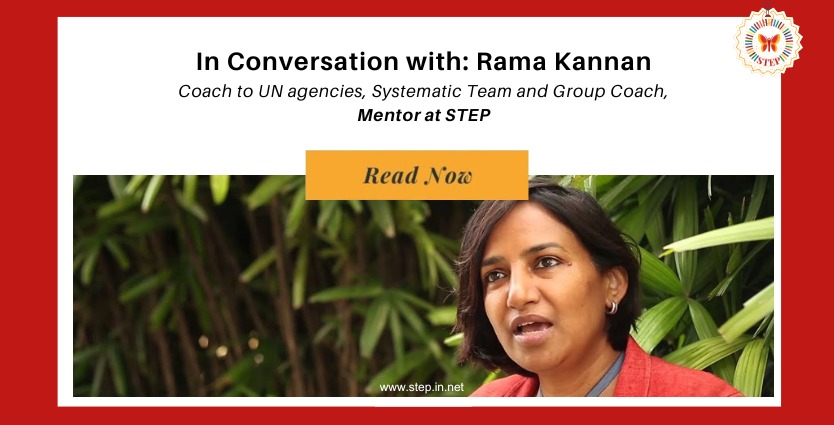
    It gives me immense happiness as a coach when people start believing in themselves and explore their vast potential because of our coaching conversations, and that is why I do what I do,” says Ms.Rama Kannan, mentor at STEP. She is a Coach to UN agencies, an Executive and Leadership Coach, a mentor to corporate and social sectors, and a Systematic Team and Group Coach.

    The professional journey 

    After graduation, and a law degree and diploma at IIFT, she worked in India with organizations like Pepsi. She then did a stint at management consulting with multinationals wanting to enter the Indian markets.

    I loved the work and decided to get a management degree,” she says.

    Rama moved to Singapore with her husband and joined NUS for an MBA in Strategy and Marketing.

    Post her MBA, she worked with British Petroleum in the Asia Pacific region.

    She quit in 2008 to explore the social sector. Kannan got an opportunity to work pro bono with CARE International to build strategies for engagement with the private sector.

    She traveled with them to developing countries in South Asia – Bangladesh, Sri Lanka, and India.

    I developed a lot of respect for people working on the ground level.  However, I also realized that the work of the private sector is equally important for a country’s development,” she adds.

    She then co-founded a microfinance society in Singapore. 

    Around that time, she was offered a project through SIF (Singapore International Foundation) that partnered with UNITAR (UN Institute for Training And Research) to improve the skills and knowledge of Afghan civil servants. It was an annual 9-month capacity building program, where she co-mentored 5-6 Afghan civil servants every year in a project they took up within their organizations. During the program, she met many Afghan women and their strength surprised her.

    It was a pivotal moment for me. I was amazed by the intelligence and assertiveness of these people. It changed my perception of what is possible if you believe in someone. Working with people, especially women, was a fulfilling experience,” she says.

    She was a part of the project for 10 years till the program ended in 2019.

    Those were among the best years of my life,” she adds.

    Kannan was heartbroken when the Taliban took over Afghanistan, and the negative impact it is having on the lives of the Afghan people, especially the women, still disturbs her. 

    After returning to India, she was a mentor in the leadership program run by DASRA, which works towards the capacity building of nonprofits in India. 

    She got to know about coaching at that time and trained as a coach in Singapore in 2012. Later, she got the master coach credential degree from International Coaching Federation, the global body for coaching. 

    Coaching is about helping people look forward to understanding their aspirations, help overcome their challenges, understand and use their strengths and thus achieve their goals,” she says.

    Presently Kannan coaches senior executives in corporate and social sectors (including the UN Agencies) and is an Independent director on the board of a BSE-listed company, and sits on the advisory board of two Impact Funds. She has also been co-teaching a module on social entrepreneurship at the Indian School of Development Management since 2018.

    The shift to the development sector 

    The inequities in society bother her, and she wants to help bring a shift.

    Supporting people making an impact and helping them realize their potential is my ikigai,” she adds.

    Experience as a coach to UN agencies 

    Rama is a coach to leaders from all over the world in UN agencies like UNITAR and UNICEF. She realized that though the situations are different for every country, the root problems remain universal- people are insecure, self-critical, and lack confidence.

    “It has been an amazing experience helping people figure out their strengths,” she adds.

    Advice to women 

    In her coaching journey, Rama has seen how women are (unfortunately) more self-critical (than Men in general) and put themselves down. Conditioning and societal pressures play a big part in this.

    We all have a judge sitting inside us,” she says.

    Kannan feels women can break these barriers by building self-awareness, understanding their strengths and values, supporting each other, and mentoring.

    Rama asserts that it takes a lot of courage for women to be entrepreneurs, managing and balancing a lot of asks from many stakeholders (including the ‘critical’ self), more so than men.

    She feels that as entrepreneurs, women need to work on their financial skills and confidence.

    The STEP experience 

    Rama is a mentor at STEP, and it has been a joyful experience for her.

    Listening to the personal journey of the Steppers and helping them navigate their challenges makes me feel happy. I love the feeling that I have added value and something has shifted for them,” she adds.

    Dos and don’t for organizational culture 

    • Building trust and transparency in an organization is vital for people to reach out to each other comfortably.
    • Roles in an organization should be clear. People must understand their purpose and goals to ensure accountability for their work.
    • Trust and accountability go together.

    Helping teams achieve their goals 

    • Each team member should be clear about their personal goals and team goals.
    • Clarity on the metrics, breaking goals into milestones, and dividing the roles of each member accordingly.
    • Working with each member on their personal challenges 
    • Regular workshops and one on one meetings.

    ” Each person in the team has their own way of doing things, and these steps help bring clarity in achieving goals,” she adds.

    Rama, the person 

    Rama describes herself as a friend, a listener, and a family person. She doesn’t like being in the spotlight. Tea made by her husband is what gets her going in the mornings. She loves traveling, and visiting Antarctica is on her bucket list.

    ” I make a conscious effort to avoid being judgemental,” is her mantra for life.

Need Help?